Have scientists discovered a dark matter particle?
Dark matter is an invisible substance that is said to bind the universe; scientists in South Dakota may have found new signs of it.


In an old gold mine deep beneath the Black Hills of South Dakota, a tank of liquid xenon has been used to produce an unusual particle reaction that may be a link to “dark matter”.
Scientists conducting the experiment in the United States say they have found a single “unexplained particle interaction” that resembles a dark matter particle, though researchers have not called it a confirmed detection.
Recommended Stories
list of 3 items- list 1 of 3How Trump cuts could threaten US science leadership
- list 2 of 3NASA launches $4.3bn Roman Telescope to uncover universe’s hidden secrets
- list 3 of 3How does your name taste? The strange science of synaesthesia
“Dark matter” and “dark energy” have been detected, but no one has yet to actually observe it. The latest discovery is the closest scientists are known to have come to potentially uncovering the most elusive form of matter in the universe.
Here’s what we know.
What is dark matter?
Dark matter is an invisible substance that is believed to make up roughly 27 percent of all matter in the universe. Similarly, dark energy, thought to make up 68 percent of everything in the universe, is an invisible force that pushes galaxies apart and speeds up the expansion of the universe.
Ordinary matter, which is everything we can see and touch, accounts for only five percent of everything that exists.
Scientists found proof that this unseen matter exists in the universe by observing its gravitational pull, which affects how galaxies spin and how light bends around large clusters of it.
What it is made of and what it looks like has remained a mystery to scientists since its discovery nearly a century ago, as it cannot be detected directly because it does not reflect light or electromagnetic radiation.
The first clue to the existence of dark matter was discovered in the 1930s, when Swiss astronomer Fritz Zwicky noticed that the galaxies in the Coma Cluster were moving too fast for the cluster’s visible mass to hold them in place, suggesting something else had to be applying gravity. Similar observations were made over the following decades – all signs pointing to the presence of invisible matter, scientists said.
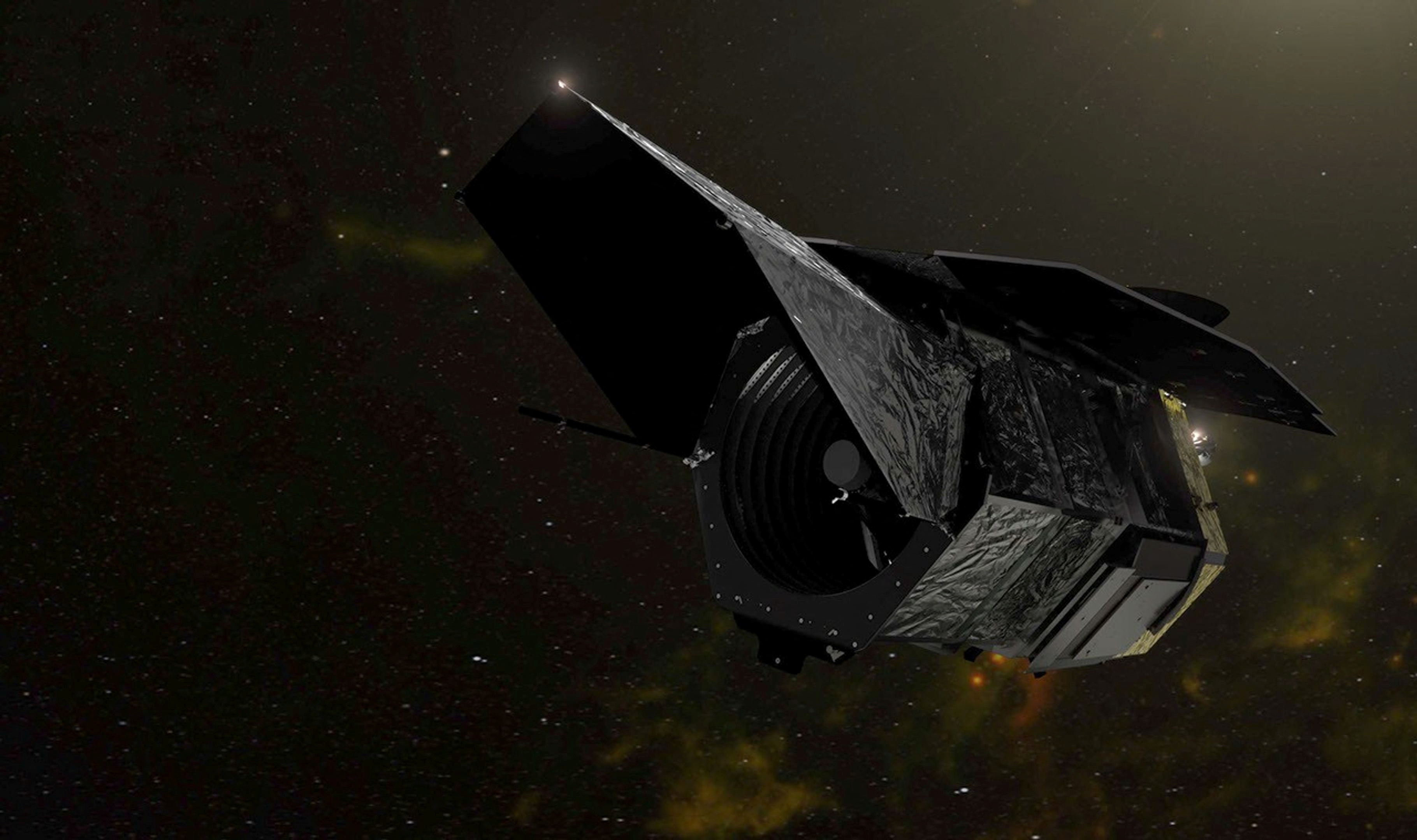
On Sunday, the US space agency, NASA, announced that it was launching a $4bn project, the Nancy Grace Roman Space Telescope, which will investigate both dark matter and dark energy.
What have scientists found in the latest experiment?
Scientists say they have found a single unexplained particle interaction that resembles a dark matter particle, though they said this is not the same as directly detecting dark matter itself.
The LUX-ZEPLIN (LZ) experiment was run by an international team of 250 scientists and engineers from 38 institutions. At its centre is an underground tank at the Sanford Underground Research Facility (SURF) in South Dakota in the United States, which holds ultra-pure liquid xenon, surrounded by hundreds of light sensors.
The theory that the experiment was testing is this: if a hypothetical dark matter particle called a WIMP (weakly interacting massive particle) reacts with the nucleus of a xenon atom, it would produce two flashes of light at a specific energy level.
After reviewing 220 days of data collected between March 2023 and April 2024, the LZ team discovered one such event on June 16, 2023.
Sam Eriksen, the lead scientist of the study and a senior research associate at the University of Bristol, presented the findings at the 2026 TeV Particle Astrophysics conference in Japan last week.
“We understand our detectors and the backgrounds so well,” Eriksen explained in a media release, “that even a single outstanding event, like the one we found, is important”.
Speaking to Al Jazeera later, he said that the key next step was to make sure that what they had found was indeed “something new” and not something picked up from the “background”.
“There are two challenges: running a detector that’s as complicated as LZ and differentiating rare backgrounds from potential signals,” he said. “The backgrounds we have occur very rarely, but so does dark matter.”
Dark matter even passes through our bodies, but it rarely ever interacts and in their detectors, fewer than five events a year are expected, he said.
Rick Gaitskell, the LZ spokesman and a physicist at Brown University, said scientists “don’t want to get ahead” of themselves.
“We are not claiming to have seen dark matter,” he added.
How significant is it?
Physicists are calling it the most compelling signal LZ has produced so far – which could be a signpost to the first real evidence of a particle that physics as we currently understand it has not been able to explain.
Theresa Fruth, a physicist at the University of Sydney who also worked on the study, told ABC News that the event is exciting because it has been re-tested several times and has held up.
“This event just won’t go away, even after many, many checks.”
For Eriksen, finding dark matter would be revolutionary because of how little we know about the universe.
“[As much as] 85 percent of the matter of the universe is dark matter,” he told Al Jazeera. “We only understand 15 percent. It could be revolutionary. We don’t know what properties it has except interacting through gravity, That’s what has made it so hard.”
