Why did Democrat Haley Stevens just endorse a Republican for US Senate?
Stevens’s endorsement of Mike Rogers comes after a bitter dispute with Democratic nominee Abdul El-Sayed.
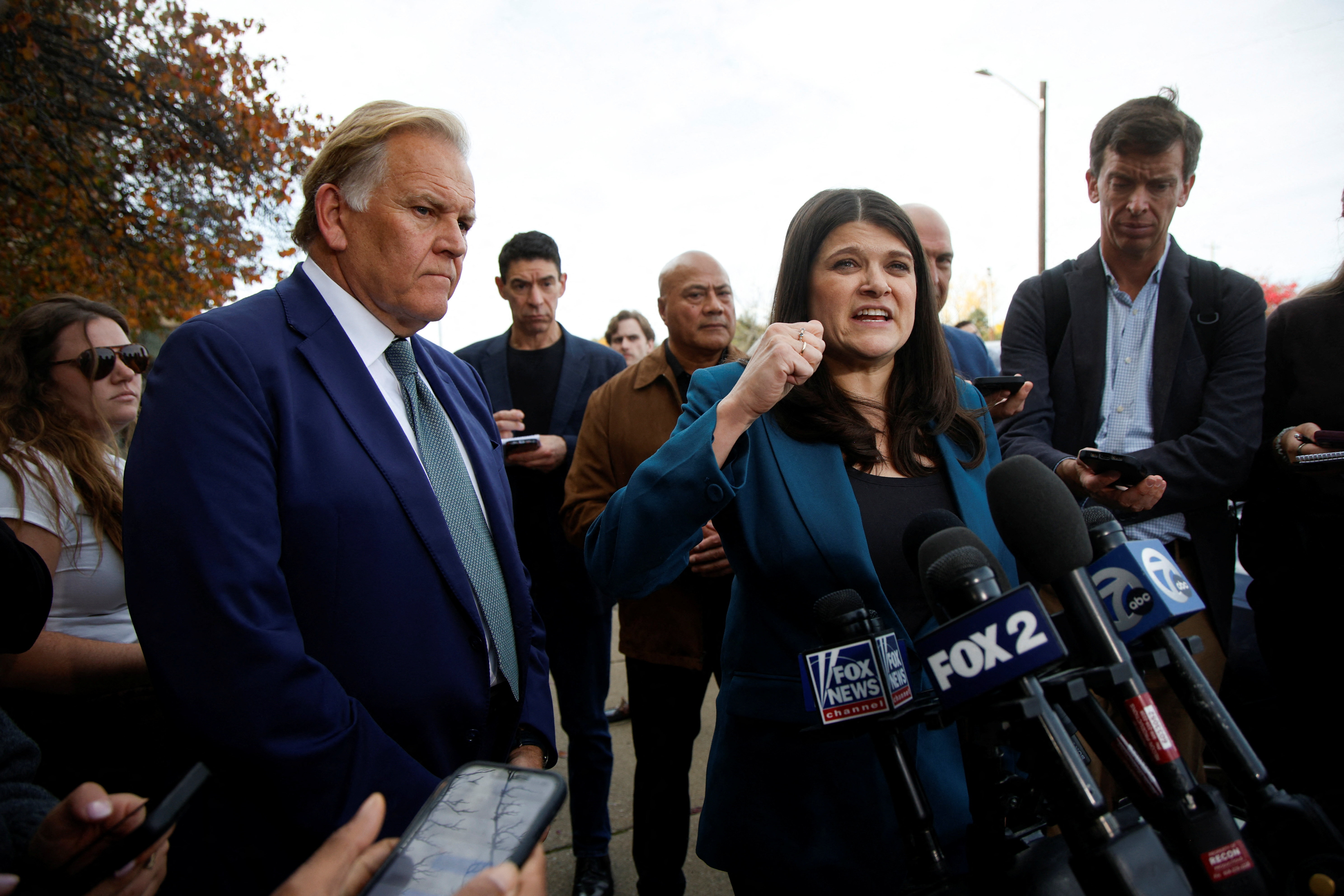

A Democratic congresswoman has thrown her support behind a Republican in one of the most closely watched races of the US midterm elections, just two days before voters head to the polls.
Haley Stevens, who lost Michigan’s Democratic Senate primary in August, announced on Sunday that she was endorsing Republican Mike Rogers over her own party’s nominee, Abdul El-Sayed.
Recommended Stories
list of 4 items- list 1 of 4Where are the most expensive midterm races and who is funding them?
- list 2 of 4Michigan race: All you need to know about Abdul El-Sayed vs Mike Rogers
- list 3 of 4More than 50 million votes cast in US midterm elections: What does it mean?
- list 4 of 4Michigan Democrat Haley Stevens endorses Republican Senate candidate
The decision follows weeks of tension between the two Democrats over Israel and has provoked a backlash within the party as it fights to win control of Congress and limit President Donald Trump’s power.
Here’s what we know.
Who is Haley Stevens?
Stevens is a Democratic congresswoman from Michigan who narrowly lost the party’s Senate primary to El-Sayed, a former public health official who could become the first Muslim elected to the US Senate.
Despite a bitter primary battle, Stevens promised to support El-Sayed and said as recently as Wednesday that she still wanted him to win.

That was despite her fiance, Jason Turkish, a Jewish Democrat and civil rights lawyer, announcing that he would vote for Rogers. Turkish – who, according to Federal Election Commission (FEC) reports, has donated nearly $250,000 to both Democrats and Republicans during this midterm cycle – accused El-Sayed of anti-Semitism, saying his rhetoric about Israel and its war in Gaza had made Jewish voters feel unsafe.
And on Sunday, Stevens changed her position.
Why did Stevens endorse Republican Mike Rogers?
The decision followed weeks of tension over Israel that became increasingly public in the final days of the campaign.
Stevens is a strong supporter of Israel, while El-Sayed has been an outspoken critic of Israel’s genocidal war in Gaza and US military aid to the country.
Their differences were also a major issue during the Democratic primary, when a super PAC affiliated with the American Israel Public Affairs Committee (AIPAC) spent tens of millions of dollars to back Stevens.
But the latest dispute began last week, when an independent group backing El-Sayed, Rebellion PAC, released an advertisement linking US military aid to Israel to Americans’ struggles with the cost of living.
The advertisement shows a couple shopping for groceries who decide to put back a carton of eggs because they need to save that money for “killing Palestinians”.
Stevens called the advertisement anti-Semitic and demanded that El-Sayed condemn it. She also accused him of making similar arguments as in the ad by suggesting that money spent on Israel could instead go towards schools, healthcare and childcare.

El-Sayed said the advertisement was not produced by his campaign and that he disagreed with its message, adding that Stevens was trying to re-litigate their primary rather than focusing on defeating Rogers.
The tensions came to a head on Sunday, when Stevens and El-Sayed were supposed to attend a church service together in a show of Democratic unity, but Stevens was uninvited.
“Our Democratic nominee for Senate said I was no longer welcome in his campaign and that I should stay away,” she said in a video on X, announcing she was going to endorse Rogers.
“And he’s right. And that’s why I am endorsing Mike Rogers for the United States Senate today.”
But Democratic Congresswoman Debbie Dingell, who helped organise the event, said she was the one who asked Stevens not to attend, telling The Associated Press news agency that “it had become way too distracting”.
Stevens also criticised El-Sayed’s association with political streamer Hasan Piker, whose uncle, Cenk Uygur, founded the PAC that released the advertisement.
Stevens told reporters on Sunday, with Rogers standing beside her: “We can’t stand with hate. We can’t stand with Hasan Piker.”
She insisted she was still a Democrat and planned to vote for Democratic candidates in 90 percent of the races on her ballot, but her Senate vote would go to Rogers.
How are Democrats reacting?
Stevens’ decision has drawn an angry response from Democrats, including some of the party’s most senior figures.
Senate Democratic Leader Chuck Schumer, who had recruited Stevens to run for the open Senate seat in Michigan, called her endorsement a “despicable betrayal”, saying Senate Democrats remained united behind El-Sayed.
He brushed off questions about whether Stevens had betrayed the Democratic Party, saying he was more concerned about the issues facing Michigan voters.
“At the end of the day, I actually don’t think about Haley Stevens,” he told reporters. “I’m just less interested in the politics of it all than I am in the policy of it all.”
He urged voters to focus instead on healthcare, civil rights and the differences between his campaign and that of Rogers, who is backed by Trump.
The Democratic National Committee (DNC) issued a blistering statement in response to Stevens’s “last-minute political stunts”.

“Haley Stevens’ disappointing decision to endorse Mike Rogers, a Trump ally who would join Republican efforts to sell out working families, is a betrayal of the values of the Democratic Party,” DNC Chair Ken Martin said.
“At a moment when Democrats are united in fighting for Michigan families and standing up to Trump’s agenda, we reject these efforts to sow division within our party.”
The local arm of the DNC, the Michigan Democratic Party (MDP), also had strong words for Stevens’ endorsement of Rogers.
“Haley Stevens’ decision to campaign with Rogers … shows that she has abandoned everything she claims to care about,” MDP Chair Curtis Hertel said. “We reject the attempts by Stevens and bad-faith actors to divide our party and undermine our momentum, and will not allow these eleventh-hour distractions deter us.”
Stevens’s decision also prompted resignations within her own team. Her chief of staff for eight years, Justin German, announced that he and several other staff members had stepped down over the endorsement.
“We are shocked and heartbroken by Congresswoman Stevens’s decision to support Mike Rogers,” German said in a statement first shared by CNN.
Trump, meanwhile, celebrated her decision.
“Wow, this is BIG!” he wrote in a social media post on Sunday.
During a rally in Iowa later in the day, the president said he would “love” it if Stevens joined the Republican Party.

“Haley said what few people are willing to say,” Trump added. “It’s a thing called bravery.”
Republican House of Representatives Speaker Mike Johnson, who flew with Trump to Iowa, also celebrated Stevens, telling reporters he sent the congresswoman a note after her “courageous” endorsement.
“Haley’s a good person. She’s always been very thoughtful”, Johnson said, describing Michigan’s Senate race as a “contrast” election. “She loves her state. She’s served it as best she could. She’s speaking the truth.”
Could Stevens’s endorsement affect the Michigan Senate race?
El-Sayed and Rogers are competing to replace retiring Democratic Senator Gary Peters in a closely contested race that could help determine which party controls the US Senate.
Republicans currently control both chambers of Congress, and Democrats are hoping to win enough seats to challenge Trump’s agenda and increase scrutiny of his administration.
Stevens defeated El-Sayed in Wayne County, which includes Detroit, and neighbouring Oakland County, drawing support from Black and Jewish Democratic voters. Both counties are Democratic strongholds, where turnout could help determine Tuesday’s result.
The question now is whether Stevens’s endorsement could convince some of her supporters to back Rogers, or discourage them from voting altogether.
Polling suggests El-Sayed has largely consolidated Democratic support, according to the Reuters news agency.
Early voting began on October 24, before the latest dispute erupted.
What comes next for Stevens?
Stevens’ bid for the US Senate earlier this year precluded her from running for her US House seat again.
Despite only having two months left in office, Stevens could face punishment from incensed Congressional Democrats when they return to Washington the week after Tuesday’s elections.
What form that punishment takes is not entirely clear, though.
The US House Democratic Caucus rules outline that, in order for a member to “maintain membership”, they “shall not participate in campaign activities for any candidate in a partisan federal election who is not a Member of the Democratic Party”.
House Minority Leader Hakeem Jeffries’ office did not immediately respond to a request for comment.

While Stevens’ endorsement of Rogers would likely not subject her to typical forms of congressional discipline, like expulsion or censure, Democrats may opt to remove her from the Democratic Caucus. Congresswoman Pramila Jayapal, a Democrat from Washington state, told POLITICO on Sunday she supports taking that action against Stevens.
But if that happens, it could end up benefiting members of Trump’s party.
Republicans currently have a razor-thin majority – 218 to 214 – in the US House. One fewer Democratic vote means Trump and his party would have a (slightly) easier time passing legislation until a new Congress is sworn in next year.
Once Stevens leaves office in January, though, her endorsement will likely cast a long-term shadow if she chooses to remain in politics – or the Democratic Party.
Hertel, in a post on social media on Sunday, wrote that Stevens “is not a current member of the Michigan Democratic Party, nor will she be in the future”.
