Bahrain says Iranian attack caused fire at industrial facility
Bahrain reports no injuries as Iran’s IRGC says it targeted US military positions at two bases in al-Riffa and Awali.
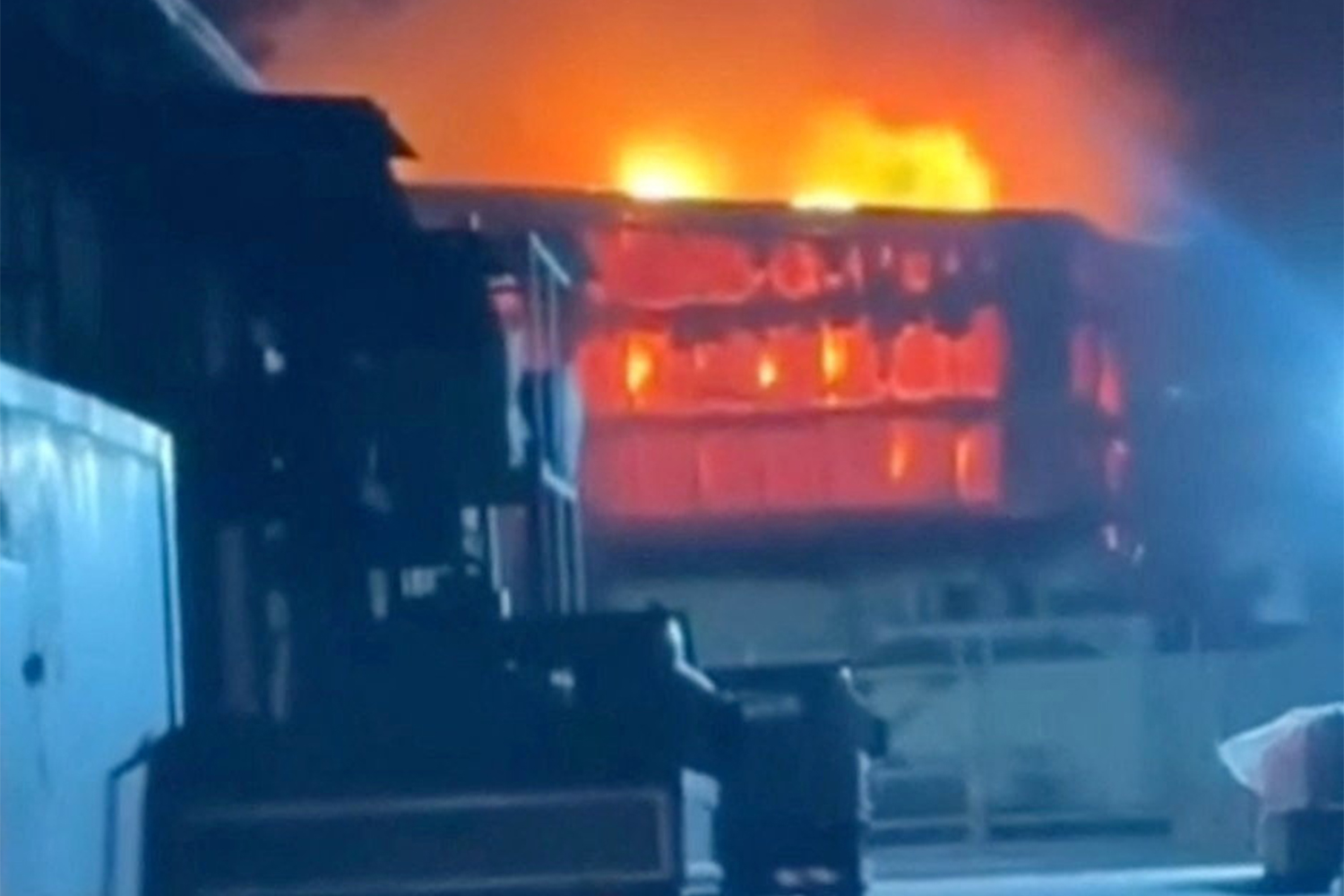

Bahrain has said an Iranian attack on a civilian industrial facility caused a fire, as Iran’s Revolutionary Guard Corps (IRGC) said it targeted US air defence radars in the Gulf country.
Bahrain’s defences intercepted several Iranian aerial attacks late on Saturday, according to the Bahraini Defence Force.
Recommended Stories
list of 3 items- list 1 of 3Bahrain thwarts drone attack; Iran claims targeting US radar
- list 2 of 3‘Too early’ to determine impact of US blockade on Iran, with Tehran defiant
- list 3 of 3US targets Iran’s ship-to-ship transfers: Can Tehran break the blockade?
In a post on X, Bahrain’s Ministry of Interior said the attack was part of “Iranian aggression”. It reported material damage but no injuries, and said civil defence teams were working to bring the fire under control.
The Interior Ministry did not name the facility or say where it was.
Earlier, air raid sirens sounded and the ministry urged residents to move to the nearest safe place without saying what the threat was before issuing an “all-clear” alert.
The IRGC said the operation was a response to continued violations of Iranian airspace, including by US MQ-1 and MQ-9 reconnaissance and combat drones, as well as an attack on a radar installation on Hengam Island.
“During the operation, US military positions at the Al-Riffa and Awali bases in Bahrain were targeted with missile and drone strikes,” the IRGC said in a statement.
“Two radars belonging to the US Army’s Patriot air defence systems … were struck,” it said, adding that any violation of Iranian airspace will be met with “a harsh and decisive response”.
“After two US MQ-1 and MQ-9 reconnaissance and combat drones violated Iranian airspace, US military positions at the aforementioned bases were targeted in an operation by the IRGC Aerospace Force,” it added.
IRGC says US escort mission failed
Bahrain hosts the US Navy’s Fifth Fleet. It has been attacked repeatedly since the US-Israel war on Iran began in late February, including three drone attacks in recent days after a lull of several weeks.
Other Gulf states have also come under repeated fire from Tehran since the US-Israel war began.
The attack on Bahrain came as multiple tankers were reportedly struck in the Strait of Hormuz, which has become the focus of the deadlocked conflict, with Iran continuing its efforts to blockade the strategic shipping line.
The US military, meanwhile, has been escorting ships through the strait, through which about one-fifth of the world’s oil passed before the war, and maintains its own counterblockade of Iranian ports.
In its statement, the IRGC claimed that US military escort and aerial protection operations in the region had failed to achieve their objectives and resulted in significant losses to equipment and vessels under US protection.
The IRGC warned that Iran’s airspace was a “red line” and that any further violations would face a “harsh and decisive response”.
US Central Command (CENTCOM), which oversees US military operations in the region, said last month it had helped Gulf countries export 1.5 billion barrels of oil via Hormuz since the summer.
Iranian Deputy Foreign Minister Kazem Gharibabadi said on Saturday that a Qatari delegation visited Tehran the previous evening and “held two hours of talks”, without providing details.
State TV reported, quoting Foreign Minister Abbas Araghchi: “The ongoing talks in the region must be given a chance, and the blockade must be lifted rationally.”
“Our position is clear: as long as Iran’s demands are not met, the discussion on the Strait of Hormuz and its opening is pointless.”
Iran’s demands include ending the war on all fronts, unfreezing Iranian assets, lifting oil sanctions and ending the US counterblockade of Iranian ports.
Reactions to latest Iranian strikes
In a statement on X, Bahrain’s Ministry of Foreign Affairs called on the United Nations Security Council to take “firm measures to compel Iran” to implement Resolution 2817.
The resolution, adopted on March 11, condemned Iranian attacks against Gulf states and Jordan, and demanded an immediate halt to hostilities and maritime interference.
The secretary-general of the Gulf Cooperation Council (GCC), Jassim Mohamed AlBudaiwi, expressed his “full solidarity” with Bahrain following Iran’s attack on the industrial facility.
He said Bahrain’s security, territorial integrity, facilities, citizens and residents are integral parts of the security of the GCC states and that the council stands united in confronting threats to their security and stability.
The GCC backs “all measures” Bahrain takes to deal with the attack, AlBudaiwi added.
Jordan condemned the strike, describing it as a “flagrant violation” of Bahrain’s sovereignty and a serious threat to regional security.
In a statement published by the Jordanian news agency Petra, the country’s Ministry of Foreign Affairs and Expatriates said the attack constituted a “dangerous escalation” and a clear breach of international law and the UN Charter.
