Iran unveils dual-missile launcher, new ‘missile city’: What to know
Military officials tour underground facility in show of military capabilities despite US attacks.
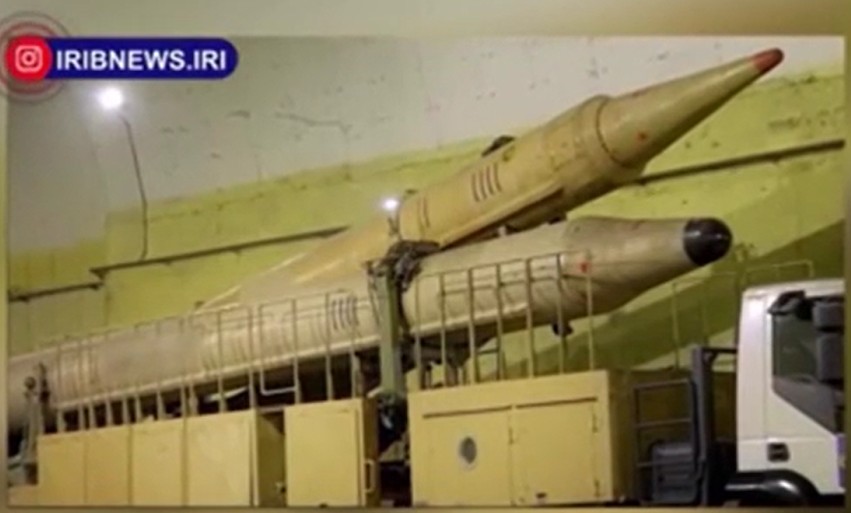

Iran is putting its upgraded missile systems and underground military facilities on display, delivering a defiant message that it still has significant military capabilities despite US-Israeli attacks.
The latest showcase included a dual-missile launcher capable of firing two liquid-fuelled missiles simultaneously, according to state media broadcasting footage of military commanders touring an underground missile facility.
Officials insisted Iran has strengthened its missile and air-defence capabilities since previous rounds of fighting, including the launch of the US-Israel war in late February. Still, Iran is under mounting economic pressure from a naval blockade imposed by the United States that has disrupted its oil exports.
Here’s everything to know about the new dual-missile launcher and Iran’s “missile city”:
What is the new launcher?
Iran has developed a range of ballistic and cruise missiles over the past three decades.
The new dual-missile launcher was unveiled as Major-General Ahmad Vahidi, commander of the Islamic Revolutionary Guard Corps (IRGC), toured the underground facility on Saturday.
The IRGC aerospace force flaunted its range of upgraded missiles and military equipment, including the launcher, which is designed to carry and fire two liquid-fuelled missiles simultaneously, according to state broadcaster IRIB.
Liquid-fuelled missiles are launched vertically and offer speed-control capabilities, which can aid in overcoming air defence systems, IRIB reported.
State media said the latest generations of Iranian missiles have improved in range, accuracy and guidance capabilities independent of the US Global Positioning System (GPS).
What is known about the underground ‘missile city’?
Vahidi’s tour followed the IRGC aerospace force’s announcement of a new underground facility on November 10, according to the semiofficial Tasnim News Agency.
Tasnim said Iran is constructing underground military complexes able to continue weapons production and storage even under heavy bombardment.
The IRGC has said it transferred its missile and drone production lines from the surface to underground facilities to allow it continuing missile production.
Footage broadcast by IRIB on Saturday showed kilometres of tunnels and hundreds of missiles and launchers, including double launchers, among other systems.
Reporting from Tehran, Al Jazeera’s Resul Serdar said it was not clear when the state broadcaster’s footage of the underground site was filmed.
“The IRGC are trying to send a message to the outside world that they are not short of ammunition; they have enough missiles and enough launchers,” he said.
“If the war resumes again, they are going to deploy these capabilities,” he added. “It is a part of their propaganda, but also, Iran is flexing its muscles and trying to restore deterrence.”
Rami Khouri, a public policy fellow at the American University of Beirut, said Iran can safely store spare parts, raw materials and chemicals needed for creating missiles and drones at its underground sites in addition to storing finished missiles and drones.
Iran has been planning for such a scenario for decades, he said. “So there’s no doubt that Iran has stored an enormous amount of all of this,” Khouri, who is also a nonresident senior fellow at the Arab Center Washington DC, told Al Jazeera.
“They’ve shown … they’re prepared to stand sanctions and keep fighting.”
What is Iran trying to achieve by showcasing its defence capabilities?
Rob Geist Pinfold, a lecturer in international security at King’s College London, said Iran is now more emboldened than ever to assert its military capabilities due to the outcome of the US midterm elections, in which President Donald Trump’s Republican Party suffered sweeping losses.
The rising cost of living as a result of the war on Iran was a major factor in how people in the US voted in the elections, which saw Democrats winning control of both chambers of Congress.
“So [Trump] looks more like the boy who cried wolf,” Pinfold told Al Jazeera. “There seems to be a feeling that the US has been deterred or disincentivised from escalating the conflict.”
Khouri said Iran has taken a gradual approach to showing its technical and military capabilities as well as its political will to strike back.
“[This is] all designed to show the US and Israel … [that] Iran has very sophisticated capabilities that can both evade the Western defence forces and defence systems … and at the same time reach targets that it wants to hit in the countries that it decides to attack,” he said.
At the same time, Iran is suffering under the US naval blockade of its southern ports, so it feels the need to escalate because it feels backed into a corner, Pinfold noted.
He added that Iran’s economy is already in recession and there are growing fears it could suffer an even bigger hit.
“Very little if any oil is coming out of Iran at the moment,” Pinfold said.

