South Lebanon faces ‘death, destruction’ as Israel deepens invasion
Countries condemn Israel’s deepening military offensive in southern Lebanon as ‘dangerous escalation’.


Thousands of people across southern Lebanon have been forced out of their homes as the Israeli military escalates its ground invasion, pushing deeper into Lebanese territory than it has in years.
Israeli Prime Minister Benjamin Netanyahu said in a statement on Sunday that he had ordered the army to “expand its ground manoeuvre in Lebanon”.
Recommended Stories
list of 3 items- list 1 of 3Harvard Medical School graduate dedicates speech to Lebanon and Palestine
- list 2 of 3Netanyahu says Israeli forces have crossed Lebanon’s Litani River
- list 3 of 3Israeli soldiers reach Nabatieh, one of southern Lebanon’s biggest cities
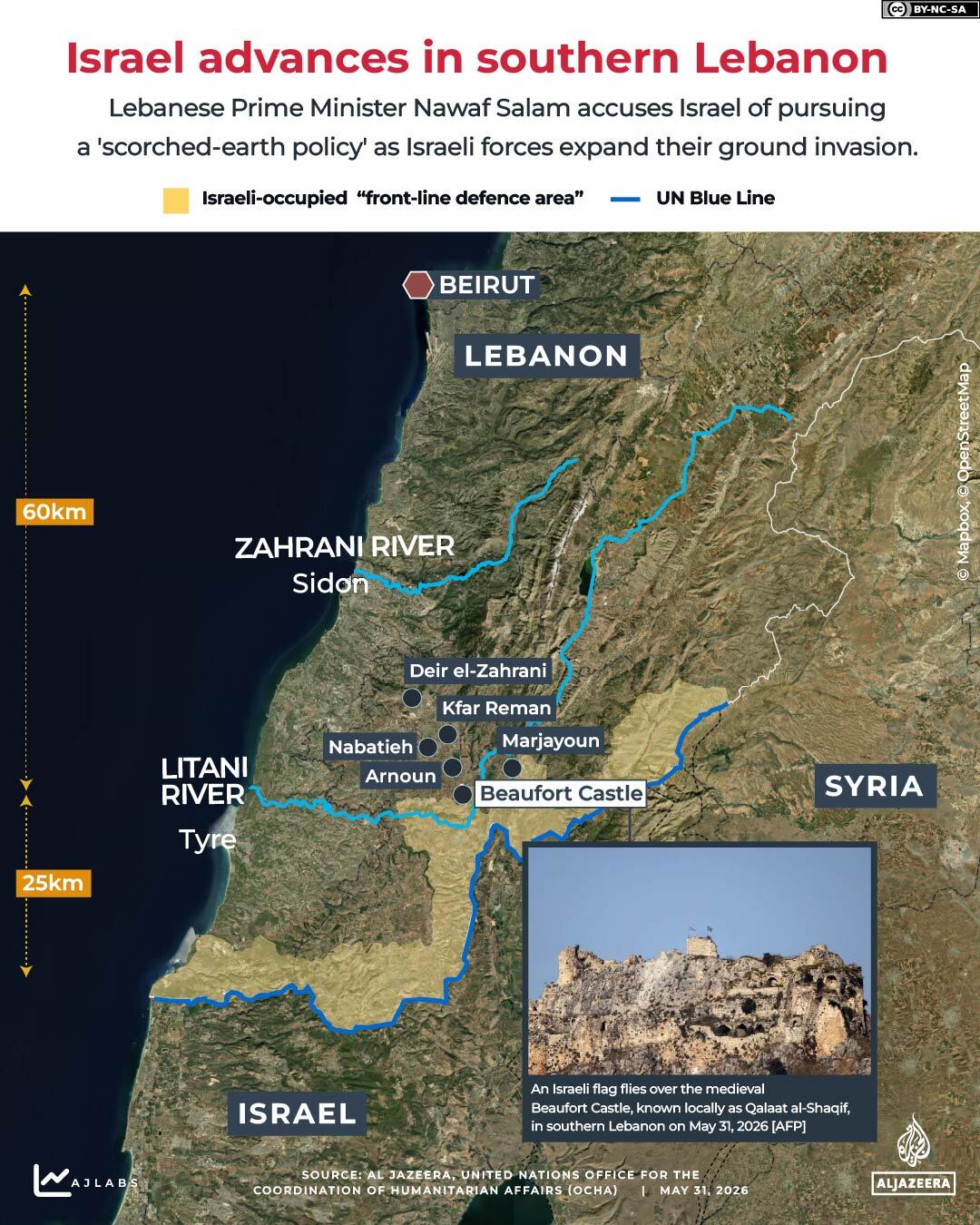
The announcement came after the Israeli military ordered all residents living south of Lebanon’s Zahrani River to leave their homes and move north, warning that anyone who remained in the area risked being killed.
Lebanon’s official National News Agency reported multiple Israeli attacks on Sunday, including an air strike that killed at least four people in the town of al-Abbasieh near Tyre.
“The entire south of Lebanon is now a conflict zone,” Al Jazeera’s Obaida Hitto reported from Tyre.
“People are being targeted in their vehicles on the main highways, and in areas north of Tyre along the road to Sidon,” Hitto said.
“So, wherever people are going here in Lebanon, they’re finding death and destruction and falling missiles. [There is] no sign of any safety here in southern Lebanon.”
Countries condemn Israeli push
Several Arab countries, including Qatar and Jordan, condemned Israel’s offensive as a “dangerous escalation”, while French President Emanuel Macron also voiced concern about the intensifying Israeli attacks.
Israel’s deepening invasion and attacks mark “an egregious violation of the sovereignty of … Lebanon and an open breach of international humanitarian rules-based order”, the Qatari Foreign Ministry said in a statement.
Israel has repeatedly ordered Lebanese civilians to immediately leave their homes as it has expanded its ground and air assault, which it says is targeting the Lebanese armed group Hezbollah.
More than one million people have been forcibly displaced across Lebanon since the latest round of fighting between Hezbollah and Israel began in early March, after Hezbollah fired rockets at northern Israel in response to the US-Israeli war on Iran.
According to the latest figures from the Lebanese Health Ministry, more than 3,412 people have been killed and 10,269 others wounded in Israeli attacks across the country since March 2.
In recent days, Israeli troops have expanded their offensive, crossing the Litani River on Friday for the first time since 2006.
Israel also seized Beaufort Castle, which sits atop a strategic hill near Nabatieh, Lebanon’s fifth-largest city. The Israeli military previously captured the 12th-century fortress in 1982 and maintained control of it until withdrawing from Lebanon 18 years later.
France rebuked Israel’s actions and has requested a meeting of the United Nations Security Council to discuss the situation in the country.
In an interview with French news network BFMTV, Foreign Minister Jean-Noel Barrot described Israel’s military campaign in Lebanon as unjustifiable.
“While we recognise Israel’s right, like that of all countries, to self-defence … nothing can justify the continuation of Israeli military operations in Lebanon and its ever-deeper occupation of Lebanese territory,” Barrot said.
Israel has been encircling Nabatieh, a city that is key to southern Lebanon’s economy and a cultural hub for the region. It is viewed by many Lebanese as a symbol of resistance due to its historic role on the front line of Israeli assaults.
Despite Israel’s advances in southern Lebanon, Hezbollah, which is backed by Iran, has continued to target Israeli forces.
Hezbollah claimed several 19 military operations against Israel by Sunday afternoon, saying that it launched several drone attacks targeting invading Israeli forces. The group also took responsibility for a rocket launch targeting the northern Israeli town of Safed.
Separately, Israel on Sunday confirmed that one of its soldiers was killed in a Hezbollah drone attack a day earlier, bringing the total number of Israeli soldiers killed since the current round of fighting escalated to 25.
Hezbollah has been deploying fibre-optic drones that are resistant to electronic jamming and near-impossible to detect by radar. The low-cost aircraft have been able to penetrate Israel’s multi-layered air defence systems, which are valued at billions of dollars.
‘Scorched-earth policy’
Meanwhile, Lebanese Prime Minister Nawaf Salam has denounced Israel’s invasion, accusing the country of pursuing a “scorched-earth policy” and imposing “collective punishment” on residents of southern Lebanon.
On Sunday, Lebanese Parliament Speaker Nabih Berri, one of the most powerful Shia political figures in Lebanon, said he could “guarantee a full, comprehensive and immediate commitment to a ceasefire” by Hezbollah.
But “the question is, who will compel Israel to stop its aggression, by land, sea and air, and its demolition of villages and homes?” Berri was quoted as saying by Lebanese media.
Israel and Lebanon are currently engaged in peace talks facilitated by the United States.
Officials from both countries met at the Pentagon in Washington, DC, on Friday to discuss the implementation of the nominal “ceasefire” that came into effect in mid-April, which Israel has repeatedly violated.
The negotiations, which Hezbollah has rejected as Israel continues to attack the country, are expected to resume next week.
