Has Russia helped Iran target CIA sites in the Gulf?
Reports of Iran targeting sites belonging to the US's CIA first emerged in the early days of the US and Israel’s war with Iran.


When US Secretary of State Marco Rubio met Russian Foreign Secretary Sergey Lavrov on Thursday in Manila, on the margins of a summit of Southeast Asian nations, Moscow’s war on Ukraine was officially the top agenda item.
But the meeting between Rubio and Lavrov was held under the shadow of fresh reports suggesting that Russia might be playing a more active role than it has publicly acknowledged in Iran’s attacks on United States military sites in the Middle East.
Recommended Stories
list of 3 items- list 1 of 3What are ‘civilian’ sites in international law and where have US, Iran hit?
- list 2 of 3Can the Suez save Asian oil consumers after Houthis shut Bab al-Mandeb?
- list 3 of 3Ukraine’s new military chief pledges to escalate retaliation against Russia
Reports of Iran targeting sites belonging to the US Central Intelligence Agency (CIA) first emerged in the early days of the US and Israel’s war on Iran. Three days into the war, on March 3, The Washington Post reported that a CIA station in the US embassy in Riyadh had been targeted, according to two people familiar with the matter. On March 6, CNN reported, citing US intelligence sources, that Moscow had been helping Tehran locate US personnel and aircraft in the Gulf.
Now, more recently, the Reuters news agency on Wednesday reported that Iranian drone attacks on CIA facilities, specifically on the embassy in Saudi Arabia, had prompted US intelligence to investigate possible Russian involvement, suggesting that the strikes’ effectiveness and precision could suggest possible evidence of support.
Nicole Grajewski, an assistant professor at the Centre of International Research at Sciences Po university in Paris, explained that Russian involvement in Iran’s targeting was a “realistic” theory.
“This was kind of what was suspected because a lot of the attacks that Iran did were far more advanced than what they’ve done before,” Grajewski told Al Jazeera.
“Iran doesn’t have great space-based capability, unlike Russia,” she said. “Compared to Russia, Iran doesn’t have enough military-grade satellites for basic stuff… it seems likely that they struck some of the deal with the Russians.”
However, she explained that Iran has its own human intelligence-gathering networks that are “often overlooked” when it comes to the targets it selects in the region.
Russian support for Iran
Amid wars and sanctions, Moscow and Tehran have deepened their military relations.
While many analysts have argued that relations between the two countries are less of an alliance and more of a marriage of convenience against the West, Grajewski disagrees.
“They both have kind of viewed themselves as actors that are facing kind of similar threats on the global stage, and their cooperation has really intensified since the war in Ukraine, and even more so recently,” she said. “They’re much more dependent on each other.”
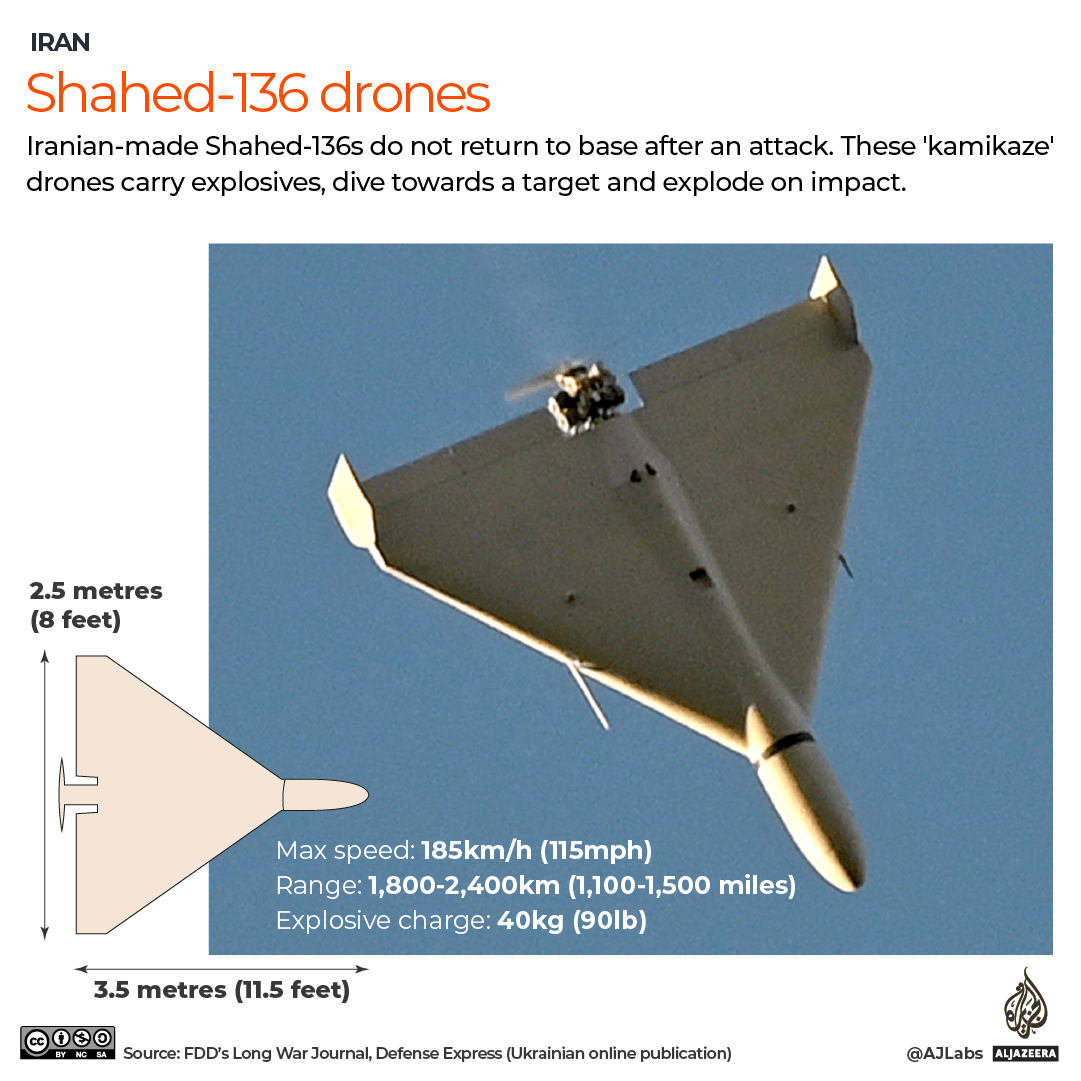
The February 2022 Russian invasion of Ukraine drew the two sides closer militarily after Tehran provided Moscow with critical weapons, most notably the Shahed drone and the Fateh-110 ballistic missile, to aid in its war efforts.
Last year, the two sides signed a 20-year Comprehensive Strategic Partnership Treaty, which had promised to increase defence cooperation.
However, The Moscow Times reported Russian Deputy Foreign Minister Andrey Rudenko saying in an address to the State Duma at the time that the treaty did not mean the “establishment of a military alliance with Iran or mutual military assistance”.
Russia has also allegedly helped Tehran improve the accuracy of its Shahed-136s by supplying the Kometa-M anti-jamming navigation system.
According to reports in March, debris that was found after an attempted Iranian attack on a British Royal Air Force (RAF) base in Cyprus recovered the Russian system from the wreckage of a Shahed-136 drone.
Russia rejected a report by The Wall Street Journal that reported on the Kometa-M system on Iranian drones, calling it “fake news”.
Still, Grajewski explained that the US war with Iran serves to benefit Moscow to “some extent” as it diverts attention away from the Ukraine war and has the potential of weakening the US’s global power.
“I think the Russians view this as kind of a broader battle for a global order, and they see this as kind of the real cascade that might lead to American decline,” she said.
“Obviously, they don’t want to see Iran fall, and so that’s always been this kind of delicate balance between having Iran go at it alone against the United States, but also making sure that Iran has enough support to survive and withstand a very difficult moment in their history, too.”
Recent attacks
More recently, the US and Iran have intensified their exchange of attacks. US strikes on Iran have continued for the 12th consecutive night, killing at least two people in an attack on the Shalamcheh crossing on the border with Iraq on Thursday morning. Iran has struck back with attacks on multiple Gulf countries and Jordan in recent days.
And ultimately, Grajewski said that Iran’s own tactics are proving to have more of an impact on the course of the war than any Russian intelligence help.
“Russian involvement isn’t the fundamental tipping point for the Iranians. Iran already had these capabilities; they’ve already developed an extensive drone force, extensive missile force,” she said. “What it did do is give Iran a bit of an edge and improve it.”
