US launches ‘heavy wave’ of new attacks on Iran
Iranian media report that a couple and their two-year-old child were killed in the latest US attacks on Qeshm island.
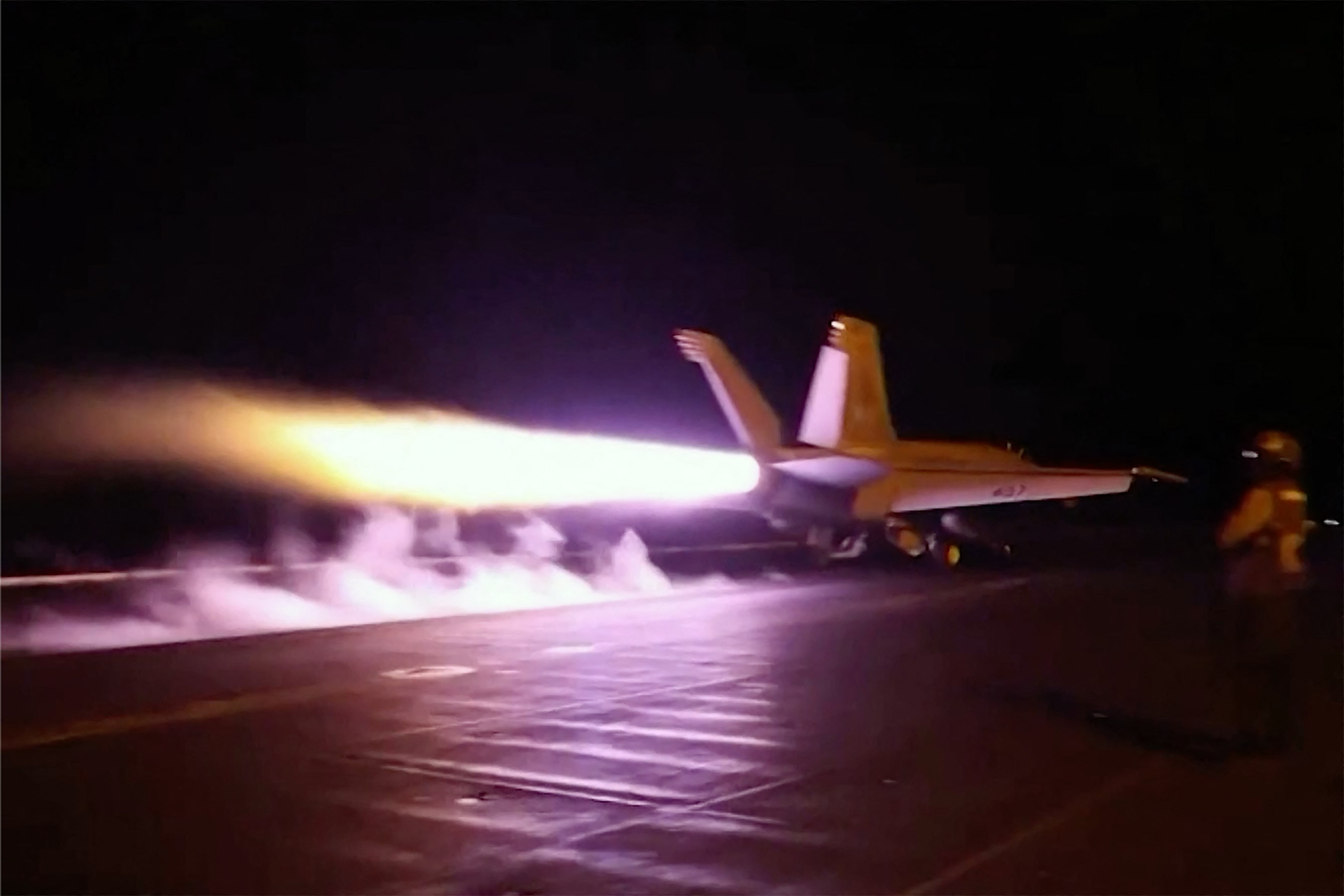

The United States has launched a “heavy wave” of attacks against Iran after a five-night pause, following Iranian missile attacks on US forces a day earlier.
The US military’s Central Command (CENTCOM) said it had “successfully completed a heavy wave of strikes against Iran” as of 10pm ET on Wednesday (02:00 GMT on Thursday). It said the attacks were in response to Iranian strikes on US forces stationed at a US base in Jordan a day earlier.
Iranian media reported that three civilians were killed in the latest strikes. Iran’s Islamic Revolutionary Guard Corps (IRGC) also said three of its personnel were killed in a US missile attack.
After the US attacks, Jordan and Kuwait reported Iranian strikes on their territory on Thursday. Kuwait said one person was killed.
CENTCOM claimed its strikes hit dozens of IRGC targets, according to a statement posted on X, including “military command centres, missile and drone facilities, coastal surveillance and defence sites, and maritime capabilities”.
The attacks came hours after US President Donald Trump promised to hit Iran “very hard”.
Reporting on the casualties from the US attacks, Iranian media said a couple and their two-year-old child were killed when the residential building they were in was struck on Qeshm island – the biggest island in the Gulf.
Bombings were also reported in the southwestern cities of Ahvaz and Abadan. The semi-official Tasnim News Agency reported that power outages occurred in Ahvaz as a result of the strikes. The city is in Iran’s oil-rich Khuzestan province.
A deputy security minister in Khuzestan also told Iran’s state broadcaster IRIB that US forces targeted “some locations in Abadan”.
In addition, attacks were reported in the southern province of Bushehr, as well as the cities of Kazerun and Farashband in the southwestern Fars province.
Reporting from Tehran, Al Jazeera’s Resul Serdar Atas said these latest attacks are “concentrated in Iran’s southern provinces, particularly those along the Gulf and the Strait of Hormuz”, similar to the US attacks during a recent 13-day campaign.
The US had paused its attacks on Iran on Friday after nearly two weeks of continuous nightly strikes.
The IRGC has said that as long as Washington’s threats continue, Tehran’s resistance will also go on, pledging to respond “today”.
Iran targeted a US airbase and command headquarters in Jordan after the US strikes on Thursday. Amman did not report any casualties, but the Jordanian Armed Forces said it intercepted five missiles launched by Iran.
Saudi Arabia denounced Iran’s strikes on Jordan as a violation of “international law and the principles of good neighbourliness”, the state-run Saudi Press Agency reported.
Separately, Kuwait’s Defence Ministry spokesperson said on X that an Iranian strike hit a building belonging to a Chinese company in the north of the country, killing a worker and inflicting significant damage.
Major-General Saud Abdulaziz al-Otaibi said authorities had begun taking necessary measures to deal with the incident.
Talks continue
Despite what appears to be a surge in tensions, Pakistan has sought to reassure the international community, insisting that talks between Tehran and Washington are still under way.
“Negotiations between parties are ongoing, particularly on [the] Strait of Hormuz and to de-escalate,” Pakistani Foreign Ministry spokesman Tahir Andrabi told reporters in Islamabad.
Iran’s Foreign Ministry spokesperson Esmaeil Baghaei said on Thursday that talks with Omani officials over the Strait of Hormuz were continuing through several rounds in Tehran.
“What is clear is that currently, the Strait of Hormuz is closed due to American actions and the insecurity that America has imposed on this waterway,” Baghaei told the ILNA news agency. “International shipping is being harmed and damaged solely because of American actions.”
He said the situation was the result of “military aggression” by the US and Israel that began on March 28 and continues in various forms. Baghaei cited attacks on Iranian vessels, what he called an illegal blockade of ports and transit routes, and continuing strikes against Iran.
Analysts have begun to question whether a diplomatic breakthrough is still possible following the escalation in hostilities between the US and Iran, which began earlier this month.
Escalation options
Ryan Bohl, a senior Middle East analyst with RANE Network, a risk intelligence company, says the US has two likely escalation options.
“The first is the repeat of what America was doing prior to last Friday, which is focusing on targets and infrastructure related to Iran’s blockade of Hormuz,” he said.
“Or it could be an escalation towards the bridges and power plant strategy that President Trump has repeatedly threatened over and over again.”
The US is eager to end Iran’s control of the Strait of Hormuz, through which a large percentage of global oil shipping passes.
Earlier, Iran rejected an Omani proposal on co-managing shipping routes through the strait.
The US Department of the Treasury announced new sanctions on Wednesday on two Iranian firms it said are integral to an IRGC-backed “scheme” that forces commercial vessels to buy insurance to transit Hormuz.
“The United States will not allow Iran to hold global commerce hostage or use international shipping to finance the IRGC’s terrorism, aggression, and repression,” Treasury Secretary Scott Bessent wrote on X.
CENTCOM claimed the latest strikes aimed to “further diminish threats posed by Iran and its proxies to American forces, commercial shipping, and neighboring Gulf nations”.
Former Pentagon official David Des Roches told Al Jazeera that the latest US strikes were “not a very overwhelming attack”, adding that Trump is perhaps, “trying to keep things proportionate, or to keep things open for diplomacy”.
