Spain installs floating barrier off Ceuta after deadly migrant crossings
EU ministers to hold meeting next week to coordinate bloc’s response to crisis in North African Spanish enclave.
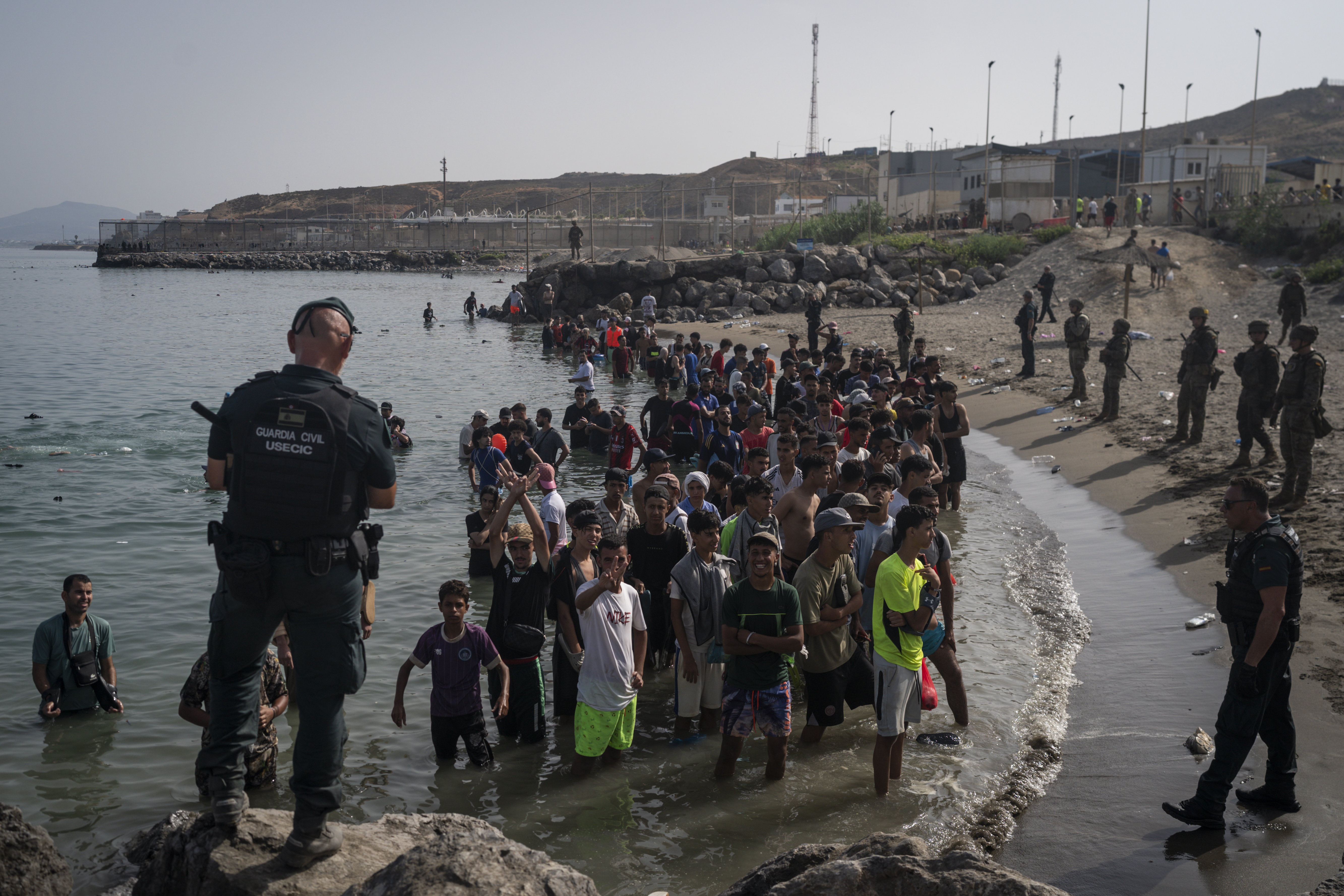

Spain has installed a 500-metre (1,640-foot) containment barrier along its sea border between its North African territory of Ceuta and Morocco following a sudden rush of migrants that left at least 67 dead.
Civil Guard officers began work early Saturday at the Tarajal breakwater, a stretch of coast heavily used during the recent migrant crossings, a surge Spain called a violation of its sovereignty.
Recommended Stories
list of 4 items- list 1 of 4Second day of Spain – Morocco border clashes amid mass migrant influx
- list 2 of 4At least 18 die as thousands cross from Morocco into enclave of Ceuta
- list 3 of 4At least 57 dead after 60,000 breach border from Morocco into Spain’s Ceuta
- list 4 of 4Spain deploys military to Ceuta after migrant surge: What we know
Authorities say “virtually all” of the estimated 60,000 migrants who stormed Spain’s North African enclave of Ceuta since Thursday have already left voluntarily, returning to Morocco. Twenty-two European Union governments have demanded an emergency response.
The death toll from crossings was raised to at least 67 on Saturday, but Spanish officials said there could be additional casualties on the Moroccan side of the border. Some of the victims drowned, while others were crushed while trying to climb the breakwater that holds the border fence.
“Virtually all those who entered Ceuta have now returned to Morocco,” Spain’s Minister of Foreign Affairs Jose Manuel Albares wrote on X late Friday.
The mass influx of migrants had dismayed EU governments, and particularly those in the Schengen area — 29 countries that have abolished border controls for travel between them.
The EU said it would hold a video meeting on Tuesday after 22 bloc members issued a joint open letter on Saturday calling for a meeting of interior ministers “as a matter of urgency” to agree a speedy coordinated response, and to “prevent further uncontrolled crossings”.
Ireland, which holds the rotating EU presidency, said it would convene the meeting on Tuesday of the EU Justice and Home Affairs Council, chaired by Irish Justice, Home Affairs and Migration Minister Jim O’Callaghan.
On Saturday, Italian Prime Minister Giorgia Meloni wrote on X: “Defending the external borders of the Union is not the interest of a single Nation. It is a shared responsibility of Europe.”
EU chief Ursula von der Leyen described the images from Ceuta as “unacceptable” on Friday, while French Interior Minister Laurent Nunez said France would tighten its borders with Spain.
‘Violation of territorial sovereignty’
Spain’s Interior Ministry said about 50,000 people had crossed the border from Morocco to Ceuta since Thursday morning, and estimated that 48,300 had returned by 6pm (16:00 GMT) on Friday.
Juan Jesus Vivas, head of Ceuta’s local government, said as many as 60,000 people had pushed across over the past couple of days.
Spanish Prime Minister Pedro Sanchez, who travelled to Ceuta on Friday, said the mass crossing represented “a violation of Spain’s territorial sovereignty”.
Vivas called for action to complete the return of all those who entered the city and strengthen security for Ceuta’s residents.
According to statements reported by Spanish media, he said that the situation had not yet returned to normal and urged Spain to enable security forces and the army to complete the return of remaining migrants.
Vivas also said more people and technology were needed to allow the Tarajal border crossing to fulfil its role as the EU’s external border crossing in Africa.
Moroccan police in riot gear used tear gas and water cannon trucks at the enclave’s border on Friday night to disperse people gathered near the fences and push them back.
“Honestly, I don’t even know why I came, and now I’m going back,” a young Moroccan man, who said he was from Tangier, told the Reuters news agency. “I haven’t eaten since lunch yesterday, even though I brought some money with me … What we’re doing is neither good nor enjoyable.”
Ceuta, together with Melilla – another autonomous Spanish city in North Africa – represent the EU’s only land border with Africa. Both cities often experience surges in attempted crossings by people seeking to migrate to Europe.
To reach Ceuta, migrants often swim from the Moroccan town of Fnideq, covering about 5km (3 miles) to reach Spanish territory. Others attempt the crossing from the nearby town of Belyounech, where the distance is shorter.
Ceuta authorities linked the surge in attempted crossings to a Spanish Supreme Court ruling earlier this month that prevented authorities from immediately returning migrants who arrive by sea. The ruling does not apply to migrants who enter Spain by land, including by climbing over the border fence.
Sanchez said on Friday that the influx of migrants was caused by mafias spreading rumours about this court ruling. But activists in Morocco expressed doubt that the ruling was behind the surge, arguing most migrants would have been unaware of such legal decisions.
Although the crossing appeared blocked later on Friday, many migrants still moved along the coast, seeking routes around the fence.
“I was late,” said Brahim, 32, who had arrived from Tangier hoping to cross through the gate, but found it effectively shut.
