Nepal-Tibet floods: What happened, what caused them and who is missing?
More than 390 killed, 1,500 missing after a glacial collapse triggered catastrophic floods in Nepal and Tibet.
Glacier collapse unleashes catastrophic downstream flooding

On Wednesday, part of a glacier collapsed high in the Himalayas, triggering catastrophic flooding along the Nepal-Tibet border.
More than 390 people have been confirmed dead, while more than 1,500 remain missing across Nepal and China’s Tibet.
Recommended Stories
list of 2 items- list 1 of 2Nepal says 359 people killed in Himalayan flash floods; over 1,400 missing
- list 2 of 2Rescuers search for survivors after Nepal–China floods kill at least 165
In Nepal, at least 389 people have been killed, while hundreds remain missing, including hundreds of foreign nationals. Across the border, at least three people have died in Tibet’s Gyirong County, where 558 remain missing, including 260 foreign nationals.
Here is what we know about what triggered the disaster, where the floods struck and the risks facing the rapidly warming Himalayan region.
What happened in Nepal?
At about 8:40am local time (02:55 GMT) on Wednesday, flash floods and mudslides swept through mountainous areas along the Nepal-Tibet border.
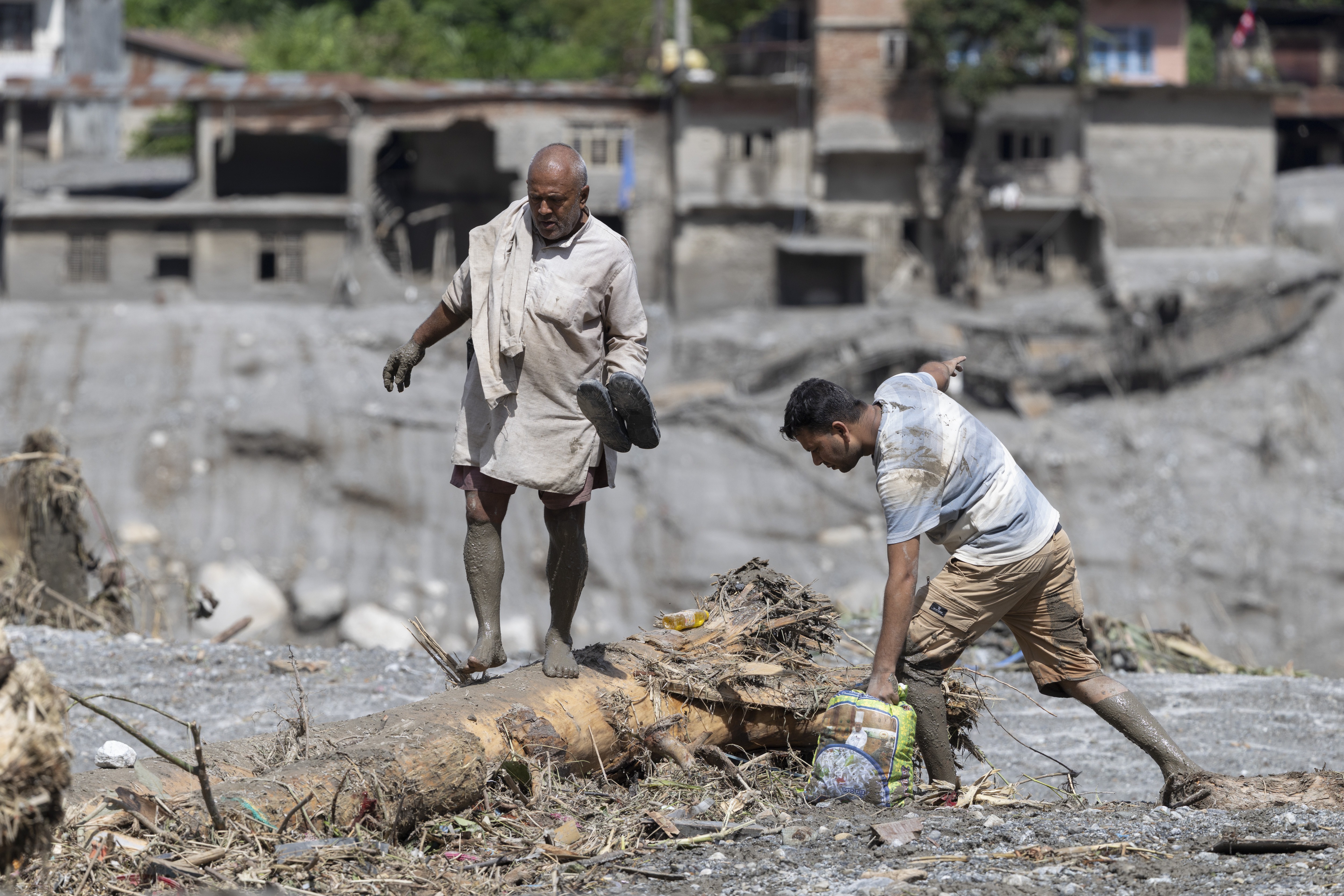
A huge surge of water, mud and rocks swept through the Lhende Khola river valley, engulfing villages and destroying homes and critical infrastructure. At least 19 bridges and about 40km (25 miles) of roads were washed away.
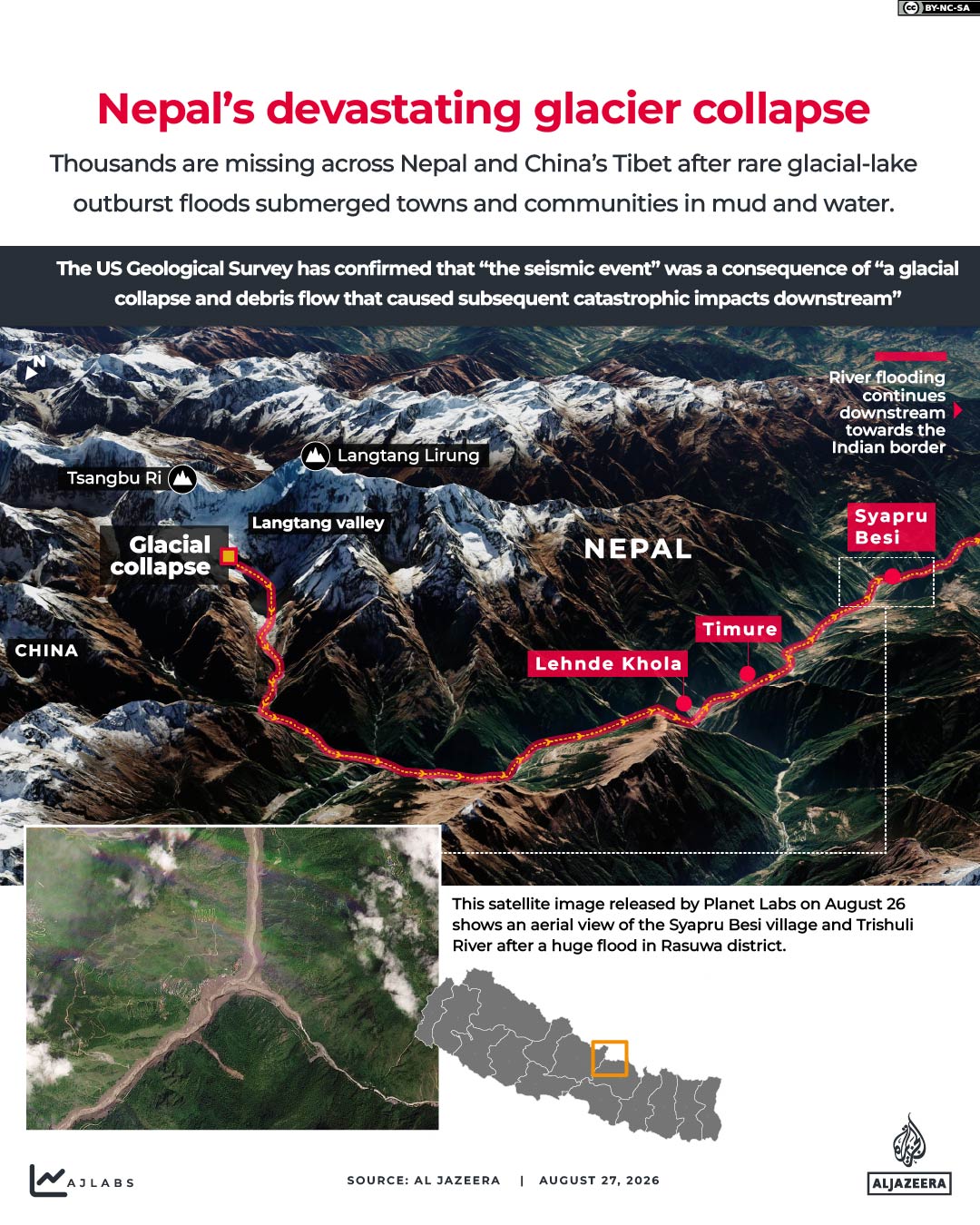
Nepalese soldiers and rescue teams have been deployed with helicopters, drones and search dogs, but high river levels, damaged roads and mud have complicated efforts to reach some of the worst-hit areas.
On Friday, Nepal News reported that the army had rescued about 350 workers and residents trapped in a tunnel at the Upper Trishuli hydropower project amid poor weather and high river flows.
Across the border in Tibet, deep sediment has also delayed Chinese rescue teams trying to reach the border zone.
Chinese Premier Li Qiang visited the disaster area in Tibet on Thursday to oversee emergency rescue and relief operations.
What triggered the mudslide and flash floods?
Officials were caught off-guard by the floods on Wednesday because it was not raining, according to local news editors.
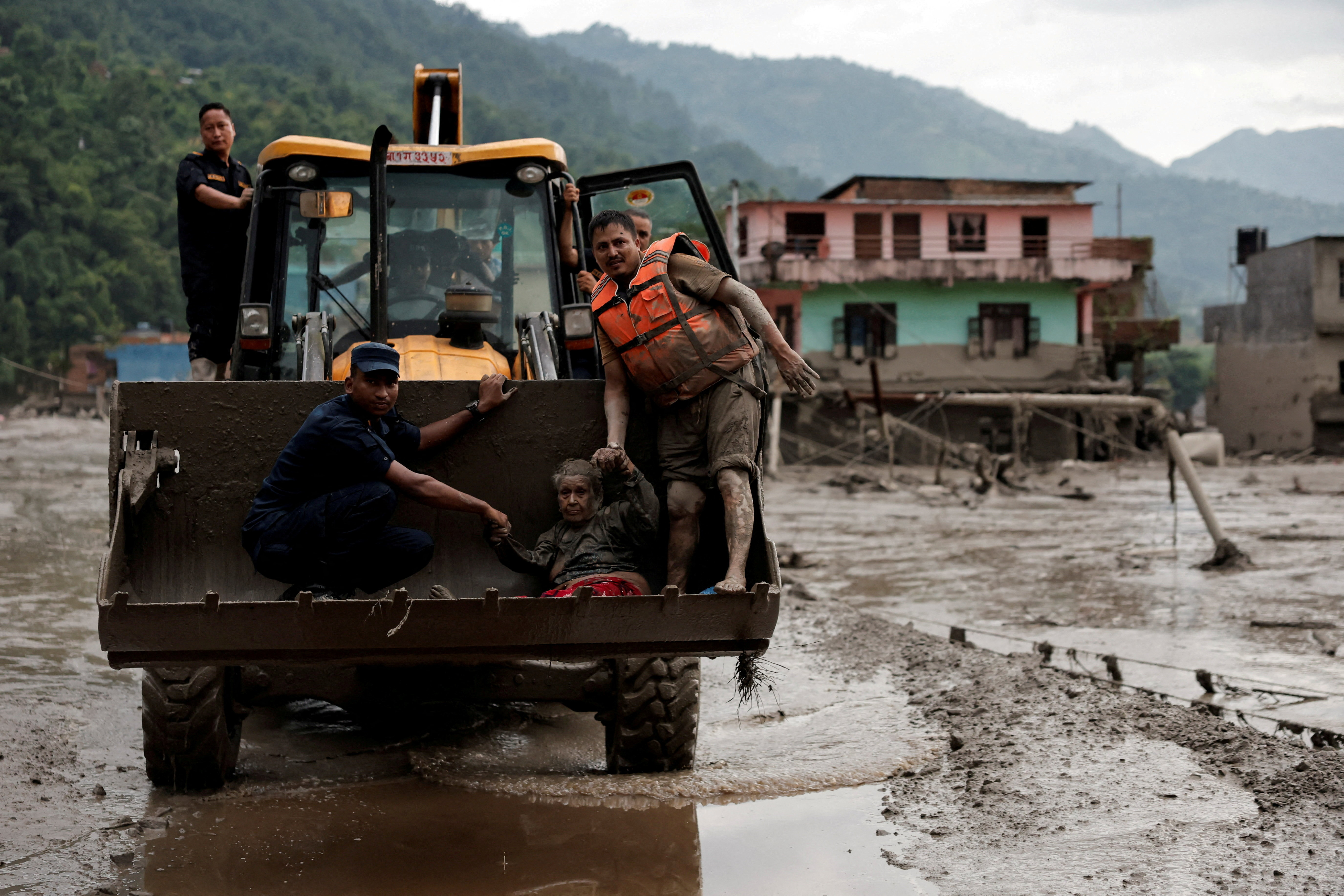
The disaster appears to have begun high in the Himalayas, where part of a glacier collapsed, sending a powerful surge of water and debris downstream.
Satellite imagery showed that a substantial section of the lower end of the glacier broke away at an elevation of about 5,200 metres (17,000 feet), plunging about 1,200 metres (3,900 feet) onto the valley floor and gathering rock and sediment as it fell.
The resulting ice-rock avalanche struck the Lhende River in Tibet, about 20km (12 miles) northeast of the Nepal-China border crossing. Debris temporarily blocked the river before the natural dam gave way, releasing a powerful flood downstream.
Early reports suggested that a magnitude 4.4 earthquake had triggered the collapse. However, the United States Geological Survey (USGS) later revised its assessment, saying the seismic signal had been generated by the landslide itself rather than an earthquake.
The landslide eventually registered as a magnitude 5.2 seismic event.
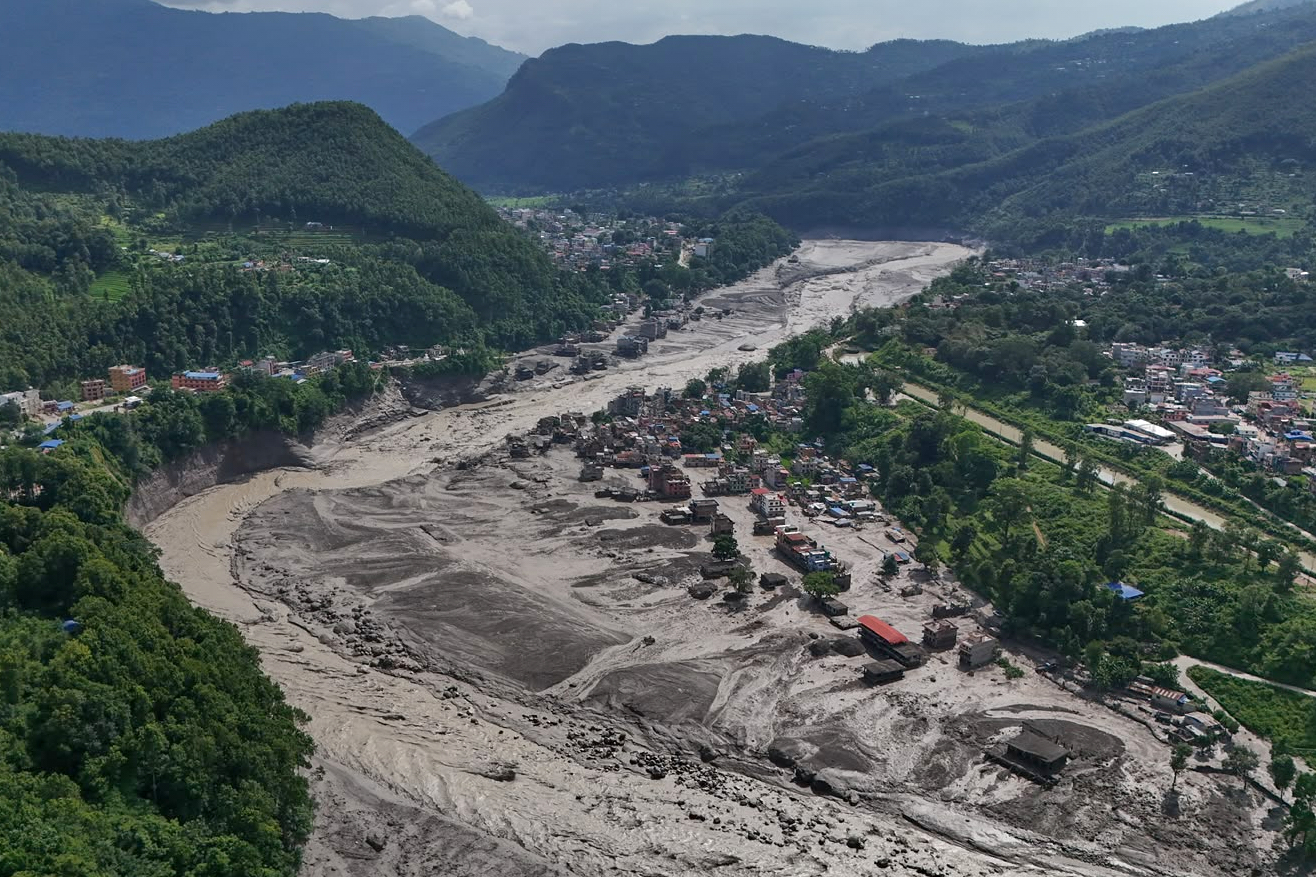
![A drone view shows mud covering properties following the flash flood, in the Nuwakot district, Nepal, August 26, 2026 [Reuters]](https://aljazeeranews-3fuh52rgrl.edgeone.app/wp-content/uploads/2026/08/2026-08-26T170828Z_1689808418_RC2E6NAJGRDA_RTRMADP_3_NEPAL-FLOODS-1787790524.jpg?resize=770%2C513&quality=80)
Where exactly did the floods happen?
The disaster struck the mountainous Nepal-Tibet border region, with some of the worst damage in Nepal’s Rasuwa district, immediately south of the Chinese border.
The initial surge entered the Lhende Khola, which feeds into the Bhote Koshi and then the Trishuli River, carrying floodwaters south through Nepal. Water levels in the Trishuli reportedly rose by as much as 9 metres (30 ft) in just 30 minutes.
In Rasuwa district, Timure and Syapru Besi were among the affected settlements. Further downstream, flooding reached parts of Nepal’s Nuwakot and Dhading districts.
Across the border in Tibet, mud and debris hit Gyirong Port in the Shigatse region.
The Trishuli eventually joins the Narayani River, which crosses into India’s Bihar state, where it is known as the Gandak River.
India has evacuated thousands of people from areas in Bihar, Uttar Pradesh and Uttarakhand amid concerns about rising river levels and further flooding in the Gandak basin.
What do we know about the victims?
More than 390 people have been killed and more than 1,500 remain missing across Nepal and Tibet.
- Nepal: At least 389 people have been killed.
- Tibet: Authorities have reported at least three deaths in Gyirong County, where 558 people are missing, including 260 foreign nationals.
“My brother-in-law had a liquor store here. I got a call from him this morning, and they were crying and said their entire house had been swept away,” Raju Bhadel, a local businessman in Nepal, told Al Jazeera.
Manoj Mishra, a teacher, described seeing vehicles and people being carried away by the floodwaters in Nepal. “I saw around nine trucks being swept away by the floods, including people. It’s a heartbreaking incident,” he said.
Who is missing?
In Nepal, hundreds of people remain missing. The Department of Tourism said on Thursday that 668 tourists from 34 countries had been out of contact since Wednesday morning, most of them on trekking expeditions.
Beijing’s Ministry of Foreign Affairs said 100 Chinese nationals were among those missing in Nepal.
Among those reported missing in Nepal are:
- India: 177
- United States: 90
- Australia: 34
- United Kingdom: 33
- Canada: 25
Authorities have not yet provided a complete nationality breakdown for all the missing foreign nationals.
US White House Press Secretary Karoline Leavitt has told reporters that Washington has “rescued a handful of Americans”, has “offered our help and our assistance” and is “focused on rescuing every American that we possibly can”.
Across the border, Chinese state broadcaster CCTV said 558 people were missing in Tibet’s Gyirong County, including 260 foreign nationals.
Many of those caught up in the disaster were pilgrims travelling towards Mount Kailash and Lake Mansarovar in Tibet.
The injured and rescued
At least 65 people were being treated for injuries in local hospitals and in Kathmandu.
Search-and-rescue operations are continuing, with officials warning that the death toll is likely to rise as teams reach areas that remain inaccessible.
Survivors from badly affected areas have also been evacuated by military helicopter, including some taken to hospitals in Kathmandu.
How are international organisations and leaders responding to the crisis?
Countries and international organisations have offered emergency assistance, funding and technical support.
Humanitarian and financial aid
India has sent a rescue aircraft carrying about 10 tonnes of emergency supplies to Nepal, including temporary shelters, blankets, hygiene kits, solar lamps and medicines.
Indian Prime Minister Narendra Modi spoke with Nepalese Prime Minister Balendra Shah and pledged India’s support.
The International Federation of Red Cross and Red Crescent Societies (IFRC) has released 1 million Swiss francs ($1.2m) in emergency funding.
The United Nations has allocated $2m from its Central Emergency Response Fund (CERF) to support relief efforts in Nepal.
Australia has announced $3.6m in assistance and said it would send additional consular staff to the region.
International coordination and satellite support
The United Nations has deployed personnel in Nepal to support government-led relief efforts, while its office in China has said it is ready to assist rescue operations in Tibet.
The European Union has activated its Copernicus Emergency Management Service, which uses satellite imagery to map disaster zones to help assess damage and coordinate rescue operations.
Search-and-rescue efforts
South Korea has established a government task force after several South Korean nationals working at a hydropower project were reported missing. Seoul said it planned to send a rapid-response team involving government, fire and police personnel to Nepal.
The United States said it was sending a disaster response adviser and providing $500,000 in assistance.
On the Chinese side, President Xi Jinping ordered an “all-out” search-and-rescue operation for people missing in Tibet and called for efforts to prevent further disasters.
Nepalese Prime Minister Balendra Shah travelled to Bidur in Nuwakot, one of the worst-affected districts, to assess the flood situation.
What role did climate change play in this disaster?
Scientists are still investigating what triggered the glacier collapse, and it is too early to determine how much climate change contributed to this specific event.
However, the disaster comes against a backdrop of rapid warming and glacial loss across the Himalayas. Glaciers across the Hindu Kush Himalaya mountain range – which spans Afghanistan, Bangladesh, Bhutan, China, India, Myanmar, Nepal and Pakistan – lost ice 65 percent faster between 2011 and 2020 than during the previous decade. Nepal’s glaciers have lost close to one-third of their ice volume in roughly three decades.
As glaciers retreat, mountain slopes can become increasingly unstable while meltwater can accumulate in or around glaciers, increasing the potential for sudden floods.
Satellite observations showed unusually warm conditions around the affected glacier before the collapse, with snow cover diminishing considerably and exposing more bare ice.
Researchers are investigating whether melting contributed to the glacier’s instability, but a direct link between climate change and this week’s collapse has not been established.
What is the situation now?
More than 5,000 Nepalese army and police personnel are searching for survivors and recovering bodies, while helicopters are delivering tents, food and other emergency supplies to communities cut off by the floods.
Officials have warned that the death toll is likely to rise as rescuers reach areas that remain inaccessible.
Authorities are also monitoring a new threat at the site of the original disaster.
Nepal’s disaster authority said a lake had formed at the site of the floods and was rising, raising concerns that it could burst and trigger further flooding downstream.
The warning has added to concerns for communities along the Trishuli and Gandak river systems, including areas across the border in India.