Fighting escalates in Yemen; Houthi attacks trigger alerts in Saudi Arabia
Yemen’s government accuses Houthis of killing three children as rebels claim Saudi forces carried out 54 air raids in 12 hours.
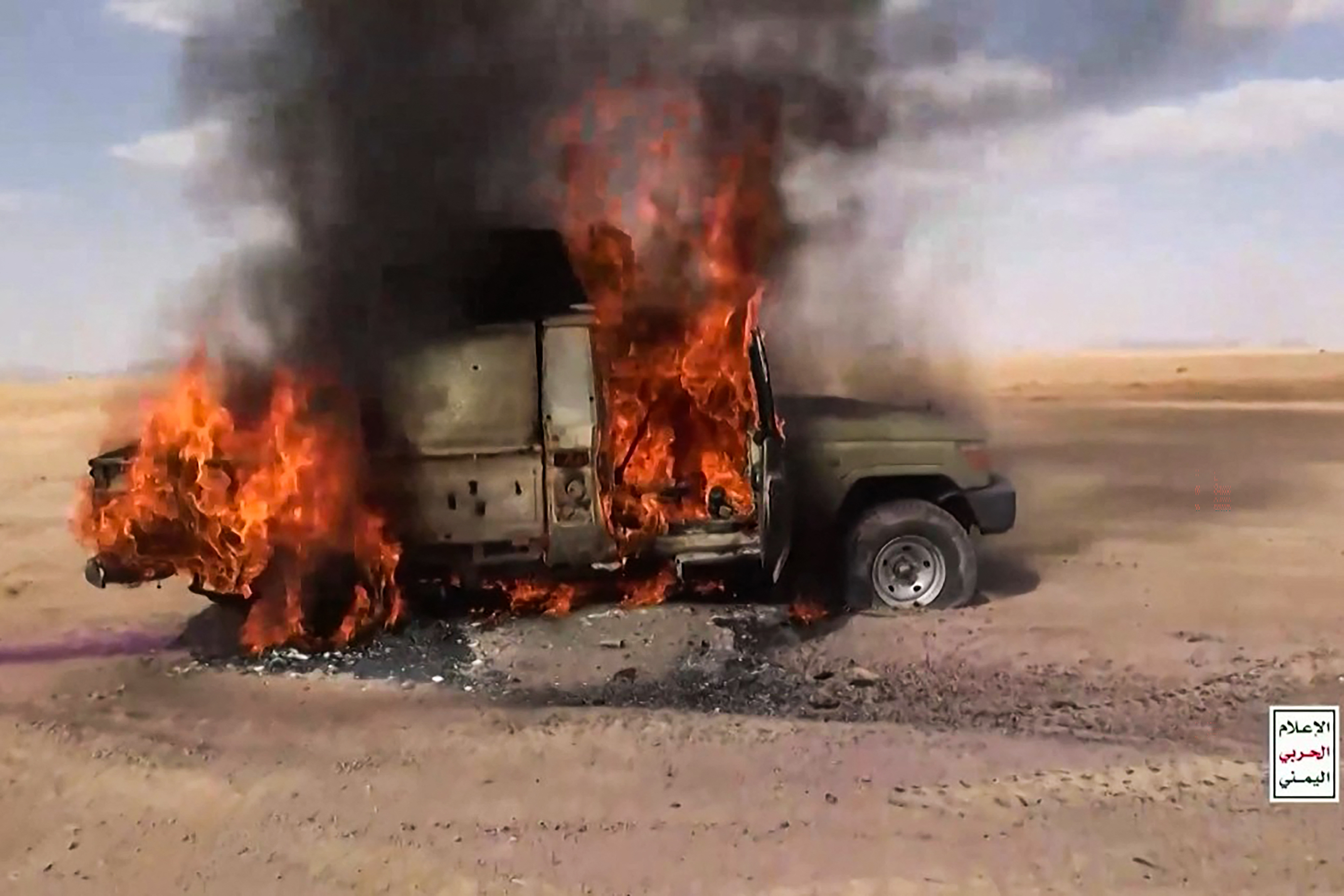
Yemen war escalates as Houthis launch major offensive and civilians flee

Fighting has escalated across Yemen, with the country’s internationally recognised government blaming the Houthis for an artillery attack that killed three children, while Saudi Arabia accused the Iran-backed group of continuing to strike the kingdom’s infrastructure.
The claims on Wednesday came as the Houthis promised to retaliate for what they said were 54 Saudi airstrikes in a 12-hour span.
Recommended Stories
list of 4 items- list 1 of 4Yemen envoy warns of wider war as Houthis threaten Bab al-Mandeb Strait
- list 2 of 4Houthi attacks on Saudi Arabia could activate defence pact, Pakistan says
- list 3 of 4Back to work, not school: Yemen’s crisis forces children to drop out
- list 4 of 4Yemen war escalates: Who are the key actors involved?
The renewed hostilities between the Saudi-backed government forces and the Houthis are unfolding amid intensifying regional tensions set off by the United States and Israel’s war on Iran. Pakistan warned on Tuesday that continued Houthi attacks could trigger the recently signed Mecca Joint Defence Agreement, a mutual security pact involving Saudi Arabia, Turkiye and Pakistan.
According to the World Health Organization, the clashes have killed or wounded more than 1,000 people and displaced tens of thousands.
On Wednesday, the government-run Saba news reported that at least three children, including a baby, were killed in Houthi shelling in the central Marib governorate. Six others were also wounded in the attack, which Saba said was the second of its kind in 48 hours.
The first assault killed two children and wounded 15 others, it said.
The Houthis did not comment on the claim, but said the death toll from what it said was a Saudi attack on a prison in the northern al-Jawf governorate on Tuesday had climbed to at least 32 people. Some seven others were wounded, the group said.
War in Yemen
Yemen has been mired in conflict since 2014, when the Houthis seized the capital, Sanaa. The attack prompted a Saudi-led military intervention the following year and a devastating conflict that killed an estimated 150,000 people.
A United Nations-brokered truce in 2022 brought a halt to large-scale fighting, but clashes resumed again in July following a strike by government forces on the Houthi-held Sanaa airport. The Houthis last week launched a major offensive in Hodeidah and Taiz provinces aimed at advancing towards the Bab al-Mandeb strait, a critical maritime waterway for Saudi oil exports.
That offensive prompted government-aligned forces to mount counterattacks and expand operations elsewhere in the country, including in the al-Jawf governorate, considered a gateway to Sanaa.
The fighting has continued to spill over into Saudi Arabia.
A spokesman for the Saudi-led coalition, Major General Turki al-Maliki, said on Wednesday the Houthis were “persisting” in attacks on the kingdom’s assets and infrastructure, adding that the rebels had targeted Khamis Mushait, Abha and Jazan using ballistic missiles and drones.
He promised that the coalition would respond to what he called the Houthis’ “heinous attacks”.
Saudi Arabia’s civil defence authority also issued multiple alerts for Khamis Mushait and Abha on Wednesday and early on Thursday.
No casualties were reported in connection with those alerts.
Earlier, a Houthi military spokesman said Saudi forces had launched 54 air strikes across six provinces over 12 hours on Wednesday, targeting al-Jawf, Marib, Taiz, Hodeidah, Saada and al-Bayda. Yahya Saree did not say whether the attacks had caused casualties, but said the aircraft involved had taken off from King Khalid Air Base in Khamis Mushait and King Fahd Air Base in Taif.
“These air strikes and the ongoing aggression against our country will not go unanswered and unpunished, by the will and power of God,” Saree said.
The Houthi-affiliated news agency Saba on Thursday said Saudi forces launched an additional 40 air strikes on the governorates of Taiz, Hodeida, Al-Jawf and Marib.
The Houthis had on Tuesday claimed that Saudi forces had carried out 121 air strikes on Houthi-controlled territory in the preceding days, including a strike on the prison in al-Jawf. The group said they retaliated with attacks on Aramco facilities in Abha, Najran and Jizan, as well as on the Economic City and Khamis Mushait Air Base.
Saudi officials said on Tuesday that recent Houthi attacks had wounded at least 73 people.
Regional tensions
Separately on Wednesday, Yemeni government-aligned forces said that they had continued advancing in al-Jawf for a third consecutive day, reaching the vicinity of Bir al-Maraziq and claiming to have severed Houthi supply lines in the area.
The forces also said they had carried out attacks on Houthi positions in Taiz, and that additional reinforcements had been sent on Wednesday to bolster the anti-Houthi National Resistance forces along Yemen’s western coast.
Those claims could not be independently confirmed.
Amid the escalating hostilities, Pakistani officials reiterated this week that any attack on Saudi Arabia could activate the Mecca Joint Defence Agreement, which Saudi Arabia, Turkiye and Pakistan signed last month to strengthen collective deterrence against future attacks.
“If there is unprovoked aggression, or a spillover of whatever is happening in Yemen into Saudi Arabia, definitely the Mecca agreement will become operational,” Pakistan’s Defence Minister Khawaja Asif told local media.
Iran meanwhile sharply criticised a statement issued earlier this week by Arab League foreign ministers, who condemned what they called “Iranian violations of Yemen’s sovereignty”.
In response, Iran’s Ministry of Foreign Affairs said it “completely rejects the claims regarding Iran’s interference in the affairs of Yemen,” adding that it had “consistently emphasised the need to preserve Yemen’s unity and territorial integrity”. It also said it had supported Yemeni-led dialogue based on a UN-backed roadmap.
