Saudi Arabia promises to respond to Houthi attacks ‘firmly’
Saudi-led coalition promises to respond ‘firmly’ to Houthi strikes on urban areas in Saudi Arabia.
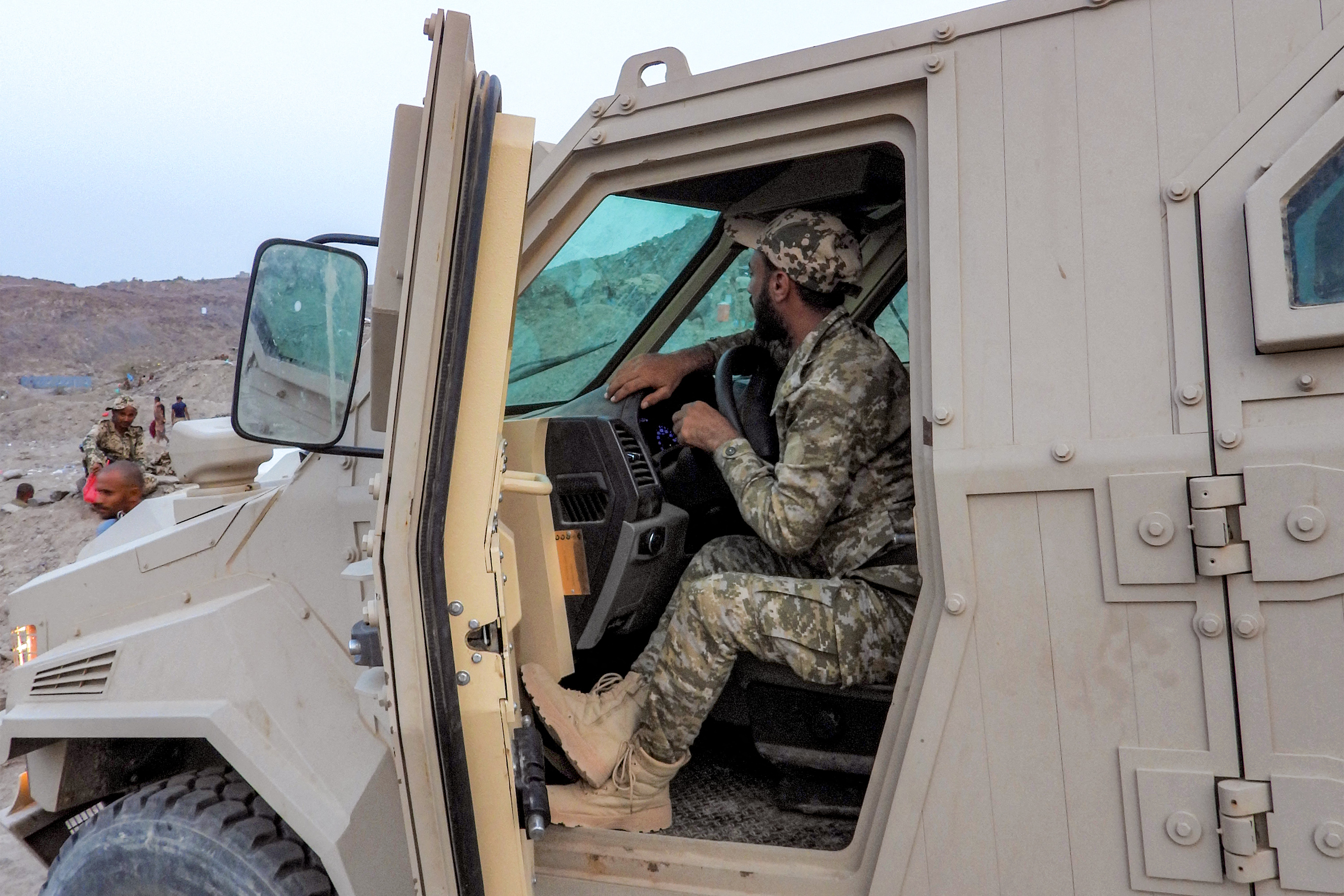
Houthis pledge to continue attacks on ‘Saudi military concentrations until aggression ceases’

The Saudi-led coalition fighting in Yemen has promised to respond “firmly” to missile and drone attacks by the Iran-aligned Houthi group that wounded 13 civilians across three cities in the kingdom.
The Saudi-led coalition, which backs Yemen’s internationally recognised government, said early on Tuesday that Houthi attacks on Khamis Mushait, Abha and Taif caused minor to moderate injuries and damaged seven homes and two vehicles.
Recommended Stories
list of 3 items- list 1 of 3Why the Houthi advance towards Yemen’s Marib, Taiz matters
- list 2 of 3Inside the Houthis’ expanding war economy in Yemen
- list 3 of 3Why Saudi Arabia’s East-West pipeline matters for global oil
“The Joint Forces Command of the Coalition will deal with these attacks responsibly and firmly to protect the sovereignty of the kingdom,” said coalition spokesperson Major-General Turki al-Maliki.
The United Nations Office for the Coordination of Humanitarian Affairs (OCHA) has warned that hostilities in Yemen have displaced at least 18,000 households – or 125,000 people – since the start of the month.
In a statement, OCHA adds that the fighting is forcing people to flee their homes, driving civilian casualties, and putting already stretched humanitarian operations under growing pressure.
Late on Monday, the Houthis, also known as Ansar Allah (supporters of God), said Saudi Arabia launched 54 air raids across the governorates of Lahj, Taiz, al-Jawf, Marib and Hajjah in the past 24 hours.
The group said Saudi air strikes hit the government complex in Khadir district, Taiz governorate, causing injuries.
Houthi military spokesman Yahya Saree said F-15 and Typhoon fighter jets operating from Saudi airbases in Khamis Mushait and Taif were used in the strikes and threatened retaliation.
Houthi-aligned media reported that the Saudi attacks killed three civilians, including two children, and injured at least two others in Taiz province’s Dhubab and Maqbanah districts.
Saudi Arabia has not commented publicly on the Houthi claims. The Saudi Ministry of Foreign Affairs did not respond to a request for comment.
The attacks come after the Iran-aligned group said that it fired dozens of missiles and drones at Saudi Arabia’s King Khalid airbase in Khamis Mushait, targeting hangars, radar systems, runways and ammunition depots, in retaliation for Saudi air raids across Yemen.
The Houthis said in a statement on Monday that Saudi warplanes had carried out 300 air raids across Yemen over the previous five days.
The exchanges of air attacks follow the Houthis’ rapid advance on the ground in western Yemen last week, with the group gaining control over much of Yemen’s Red Sea coast and advancing to areas adjacent to the Bab al-Mandeb strait.
The strait has become a vital waterway for energy and commercial shipping in the region as the United States-Iran war has caused major disruption to the Strait of Hormuz.
The forces of Yemen’s internationally recognised government said on Monday that they made advances in the contested Taiz province after retaking positions from the Houthis, and had struck the group’s fighters and equipment in Dhubab and al-Khokha on the Red Sea coast.
Al Jazeera could not independently verify battlefield claims.
Houthi and Yemeni government officials said on Monday that the Houthis had seized the Greater and Lesser Hanish islands in the southern Red Sea, about 160km (100 miles) north of Bab al-Mandeb. Their recent advances also include Mayyun Island, at the mouth of the Red Sea.
Yemen’s more than decade-long war reignited in July, as the Houthis declared a naval blockade on Saudi Arabia and began attacking its ships in the Red Sea, undermining the relative calm that followed a 2022 UN-brokered ceasefire that halted large-scale violence.
Mutual defence pact
The revival of the conflict raises questions regarding the role of Turkiye and Pakistan, who signed off on the Mecca Joint Defence Agreement – which includes a mutual defence clause – with Saudi Arabia last month.
Pakistan’s Defence Minister Khawaja Asif said last week that an unprovoked aggression against Saudi Arabia, or a spillover of the Yemen conflict into the kingdom, would make the Mecca Joint Defence Agreement operational, adding that “there should be no doubt in this”.
However, neither Ankara nor Islamabad are likely to get involved, retired Lieutenant General Tariq Khan, the former inspector general of Pakistan Armed Forces’ Frontier Corps, told Al Jazeera on Tuesday.
He asserts that the mutual defence clause is unworkable at this point in time due to the conflict in Yemen.
“Such agreements are usually never made when a crisis, war or a conflict is ongoing within the theatre for fears of it being perceived, for the right or wrong reasons, of alignments against certain countries,” he said.
He adds that even without that ongoing conflict, there’s a notable omission in the agreement that would prevent its full operation.
“If Iran is not involved, then a monumental contradiction arises, ie, structuring a regional security paradigm excluding one of the most important countries of the region.”
